Multilingual menus recover lost revenue, cut order errors, and speed up service by removing the language friction that stalls tables during peak hours. When a guest can read a menu in their own language, they order faster, ask fewer clarifying questions, and pick items they’d otherwise skip out of caution. Operator data shows average-check lifts of 12 to 18 percent within 90 days after launching a properly built digital menu, alongside meaningful drops in kitchen errors.
You don’t need a full rebuild to start capturing that value. Here’s where to begin this week:
- Turn on a digital language toggle for your top 3 guest languages, based on payment data or reservation history, not guesswork.
- Map every allergen note to one master list so it never drifts between language versions.
- Route translated orders through your POS so the kitchen always sees them in your operating language, not the guest’s.
That last point matters more than most owners realize. A centralized menu system with a single source of truth keeps prices, modifiers, and allergen flags synchronized across every language, which is where most DIY multilingual menus quietly fail.
Key Takeaways
Multilingual menus function as an operational system, not a translation task, and their value comes from centralized data, verified language quality, and staff workflows built around them.
| Point | Details |
|---|---|
| Start with guest data | Choose your first languages based on booking or payment nationality data, not assumptions. |
| Centralize allergen tags | Map every allergen to one master list so translations never drift or contradict each other. |
| Go digital first | Digital menus update instantly and cost far less over time than reprinting printed menus. |
| Preserve dish names, translate function | Keep dish names in the host language and translate ingredients, allergens, and pricing clearly. |
| Track error and check metrics | Monitor order-error rate, average check by language, and table turn time after launch. |
Table of Contents
- What Are the Real Benefits of Multilingual Menus?
- How Do You Implement a Multilingual Menu?
- How Do You Translate a Menu Without Losing Its Character?
- Should You Use AI or Human Translators for Menus?
- What Design Choices Make a Multilingual Menu Actually Usable?
- How Does a Multilingual Menu Change Staff Training?
- What Does the Research Say About Menu Language and Ordering?
- What Do Real Results Look Like After Launch?
- Why Most Restaurants Get Multilingual Menus Backward
- Frequently Asked Questions
- Sources
What Are the Real Benefits of Multilingual Menus?
The operational case is straightforward: multilingual menus remove the guesswork that causes mistakes. When a server has to verbally translate a dish description on the fly, details get lost, and that’s usually where modifier errors creep in. A guest who orders “the fish, no sauce” through a shaky hand-translated exchange is far more likely to get the wrong plate than one who reads “grilled sea bass, sauce on the side” in their own language on a screen.
- Fewer verbal translations mean fewer transcription mistakes at the point of order.
- Synchronized allergen notices reduce the risk of a server improvising an answer about nuts or shellfish.
- Faster order entry, since staff aren’t stopping to explain a dish three different ways.
- Guests defer fewer choices; language barriers reduce what researchers call preference fluency, and confused guests tend to choose conservatively or not at all.
The numbers back this up. Case data from tourist-heavy European restaurants shows guests ordering in their native language spend 15 to 23 percent more per check, largely because they’re more willing to try premium dishes and add a glass of wine when they actually understand what they’re reading. Operator data separately shows order-error rates falling by roughly 17 percent after multilingual digital menus replace single-language printed cards. The mechanism is simple: guests who understand the menu order what they actually want the first time, and staff spend less time firefighting mistakes.
How Do You Implement a Multilingual Menu?
Start with data, not intuition. Pull your reservation system or payment processor’s country-of-origin data, look at which nationalities book the most covers or the highest average tickets, and prioritize those languages first. A restaurant near a major landmark might see completely different guest patterns from one in a business district, so don’t copy a competitor’s language list.
- Identify your top 3-4 languages using booking data, walk-in patterns, or neighborhood tourism statistics.
- Choose your format. Digital menus (QR code or tablet) are almost always the better starting point because updates are instant and cost-effective, while printed menus lock you into reprint costs every time a price or dish changes.
- Decide when hybrid makes sense. Fine dining rooms with a curated, rarely-changing menu can justify a printed multilingual card. Anywhere with daily specials or seasonal rotation should lean digital.
- Set a rollout timeline. A single-location restaurant can typically go from decision to live menu in two to four weeks if translations are handled efficiently.
- Budget realistically. Digital multilingual menu platforms generally run in modest annual cost bands that are far lower than repeated print reprints, with mid-tier setups adding POS integration and low-tier options covering a basic language toggle.
Before launch, run through this checklist:
- Confirm final language selection against actual guest data, not assumptions.
- Have every translation verified by someone who understands both the language and the cuisine.
- Map each menu item to its POS entry so nothing gets lost in translation on the kitchen side.
- Cross-check allergen tags against your master list in every language version.
- Brief staff on the new digital flow before the first live shift, not during it.
How Do You Translate a Menu Without Losing Its Character?
The biggest mistake owners make is treating every word on the menu the same way. A dish name carries brand identity; an allergen warning carries legal and safety weight. Treating them identically is how menus end up either sterile or confusing.
The better approach is what researchers call the atmospheric-functional model: keep the host language for atmospheric elements like dish names and cultural framing, and switch to the guest’s language for functional details like ingredients, pricing, and allergens. A dish called “paella de marisco” doesn’t need to become “seafood rice dish” to be understood. What it needs is a clear ingredient list and allergen flag next to it, in the guest’s language.
- Use transliteration for dish names so guests can still pronounce them to a server.
- Add short cultural notes for signature dishes; a one-line story about a recipe’s origin sells more premium items than a bare description ever will.
- Pair text with images for dishes with no direct equivalent in the guest’s culture.
- Build a glossary of approved phrasing so every translator or tool uses the same terms for the same ingredients.
Quality control matters here more than owners expect. A review of menu translation research found that many restaurant translations are handled ad-hoc, often by non-specialists or raw machine translation, and the result is frequently confusing or inaccurate copy that undercuts the dish it’s describing. The fix isn’t necessarily hiring a full-time translator. It’s using a professional review pass, even a light one, before anything goes live, and keeping a running glossary so “tender” doesn’t become “soft” in one language and “delicate” in another.
Pro Tip: Run a “back translation” test: have a second, independent translator turn your translated menu back into the original language. If dish names or allergen details drift from the original meaning, you’ve caught an error before a guest does.
A short comparison shows the gap: “Pescado del día” translated flatly as “fish of the day” tells a guest almost nothing. “Catch of the day, grilled sea bass with lemon and herbs” tells them what they’re actually getting. Same source, very different outcome. Our own guide to building a great menu covers this balance in more depth for owners rethinking their full menu structure.
Should You Use AI or Human Translators for Menus?
The honest answer is both, used at different stages. Machine translation is fast and cheap for a first draft, but it routinely misses regional food terms, idiomatic dish names, and allergen nuance. Human review catches what the machine gets wrong. The workflow that holds up best in practice: machine-generate a first pass, then have someone with actual culinary and language fluency review it before it touches a live menu.
Technically, the translation layer should sit between your customer interface and your kitchen system, not replace either. The guest sees a menu in their own language on a screen. The kitchen and POS receive the order in your restaurant’s operating language, tagged with the correct item ID and modifiers. This is what prevents a server from having to manually re-translate a ticket at the pass, which is exactly where errors used to creep in before digital systems existed.
Your integration checklist should cover:
- Stable item IDs that stay constant across every language version.
- Modifier mapping so “no onions” translates correctly into a kitchen instruction, not a garbled note.
- Allergen tags stored as structured data, not free text, so they can’t drift between translations.
- Price synchronization across every language in real time.
- Support for mid-session language switching, since guests frequently flip languages mid-meal when a companion joins or a server changes.
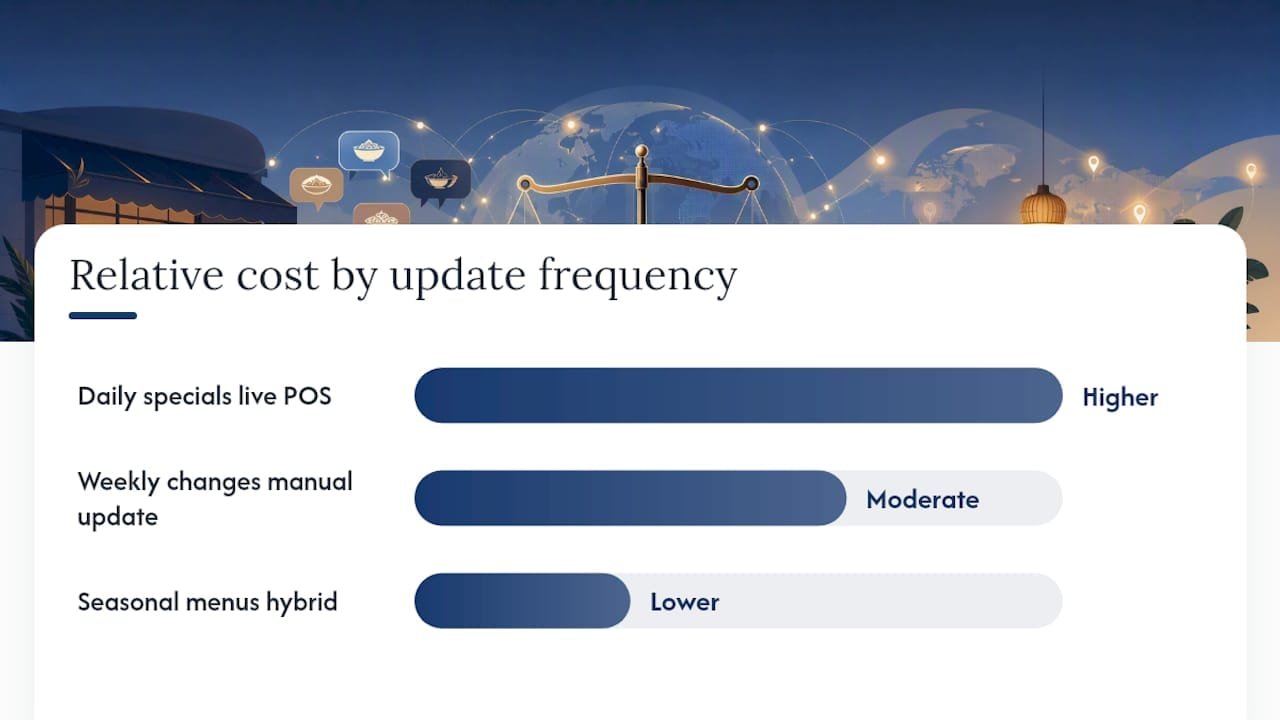
How often your menu changes should shape which technology tier makes sense:
| Menu Update Frequency | Recommended Approach | Relative Cost |
|---|---|---|
| Daily specials | Digital menu with live POS sync | Higher (requires real-time integration) |
| Weekly menu changes | Digital menu, manual weekly translation update | Moderate |
| Seasonal menus (3-4x/year) | Digital or hybrid print/digital | Lower |
Restaurants weighing broader digital infrastructure decisions may find our look at digital menu platform alternatives useful as a starting comparison point.
What Design Choices Make a Multilingual Menu Actually Usable?
A translated menu that’s hard to read is barely better than one nobody can read at all. Keep the same category structure and visual hierarchy across every language version, so a guest switching from English to Spanish doesn’t have to relearn where appetizers end and mains begin. On mobile, that means short line lengths, generous font size, and enough white space that a guest isn’t zooming in on a phone screen at a dim table.
- Use consistent icons for allergens and dietary labels across every language, so a symbol for “contains nuts” means the same thing regardless of the text beside it.
- Centralize allergen data in one system rather than translating free text separately for each language, which is exactly where drift and errors happen.
- For right-to-left languages like Arabic or Hebrew, don’t just flip the text; rework the layout so prices, icons, and categories still align logically.
- Add phonetic transliteration next to dish names in unfamiliar scripts so a guest can order verbally without stumbling.
- Use photos sparingly but strategically for dishes with no cultural equivalent in the guest’s language.
Pro Tip: On a mobile QR menu, put the allergen icon directly beside the price, not buried in a footnote. Guests scanning quickly on their phone rarely read footnotes, and that’s exactly where safety information gets missed.
Design choices here connect directly to atmosphere. Our guide to restaurant ambiance covers how visual presentation, including menu design, shapes a guest’s overall sense of your restaurant’s identity.
How Does a Multilingual Menu Change Staff Training?
The biggest shift isn’t technical, it’s behavioral. Servers stop being ad-hoc translators and start being guides. That’s a meaningful change in role, and it needs to be trained explicitly, not assumed.
- Train staff to introduce the digital menu and help guests find the language toggle within the first minute of seating, before questions pile up.
- Coach servers to confirm modifiers verbally even when the order comes through digitally, since a confirmation step catches errors before they reach the kitchen.
- Give staff a short script for common scenarios: explaining a dish, answering allergen questions by pointing to the verified tag rather than guessing, and handling a guest who switches languages mid-meal.
- Run a live walkthrough during a slow shift before the first busy weekend, so staff aren’t learning the flow under pressure.
Sample scripts help here. For a guest asking about a dish: “That’s listed with full ingredients under the dish name. Would you like me to point out any dietary flags?” For an allergen question: “Let me check the tag on that item to be sure. I don’t want to guess on allergies.” For a language switch mid-meal: “No problem, I can pull that up in either language for you.”
Track these metrics after rollout:
- Average check size by language, to see which segments are responding.
- Order-error rate and modifier mismatch incidents, compared against pre-launch baselines.
- Table turn time, since fewer clarifying questions usually mean faster turns.
- Language-specific satisfaction or informal feedback, tracked separately by guest language where possible.
What Does the Research Say About Menu Language and Ordering?
The clearest finding across the research is that language doesn’t just affect comprehension, it changes what guests actually order. A large cross-sectional study in Saudi Arabia found that culturally authentic menu descriptions produced the strongest increase in purchase likelihood of any language condition tested, with perceived quality mediating 41.2% of the total language effect and purchase likelihood rising by roughly 34% for culturally authentic wording in some guest segments.
Perceived quality is the hidden variable in most of this research. Guests don’t just need to understand a menu, they need to feel that what they’re reading reflects genuine quality. Language that reads as authentic, rather than merely translated, does more work toward a purchase decision than clarity alone.
Separate app-based research backs this up from the delivery side: roughly 59% of surveyed users said translation quality affects their satisfaction, and about 64% said poor translations actively deter them from trying a new restaurant. For an operator, the takeaway is that translation quality isn’t a nice-to-have polish item, it’s a variable that shows up directly in whether a guest orders at all.
These findings apply differently across service models. Fine dining rooms benefit most from cultural-authenticity language paired with staff who can explain nuance. Fast-casual and hotel food and beverage operations, where speed matters more, benefit more from sensory-rich, functional clarity that lets a guest decide quickly without needing an explanation.
What Do Real Results Look Like After Launch?
A mid-size tourist-area restaurant that replaced a single-language printed menu with a digital multilingual version saw average checks climb within the first quarter, tracking closely with the 12 to 18 percent lift reported across comparable operators, alongside a noticeable drop in kitchen ticket errors.
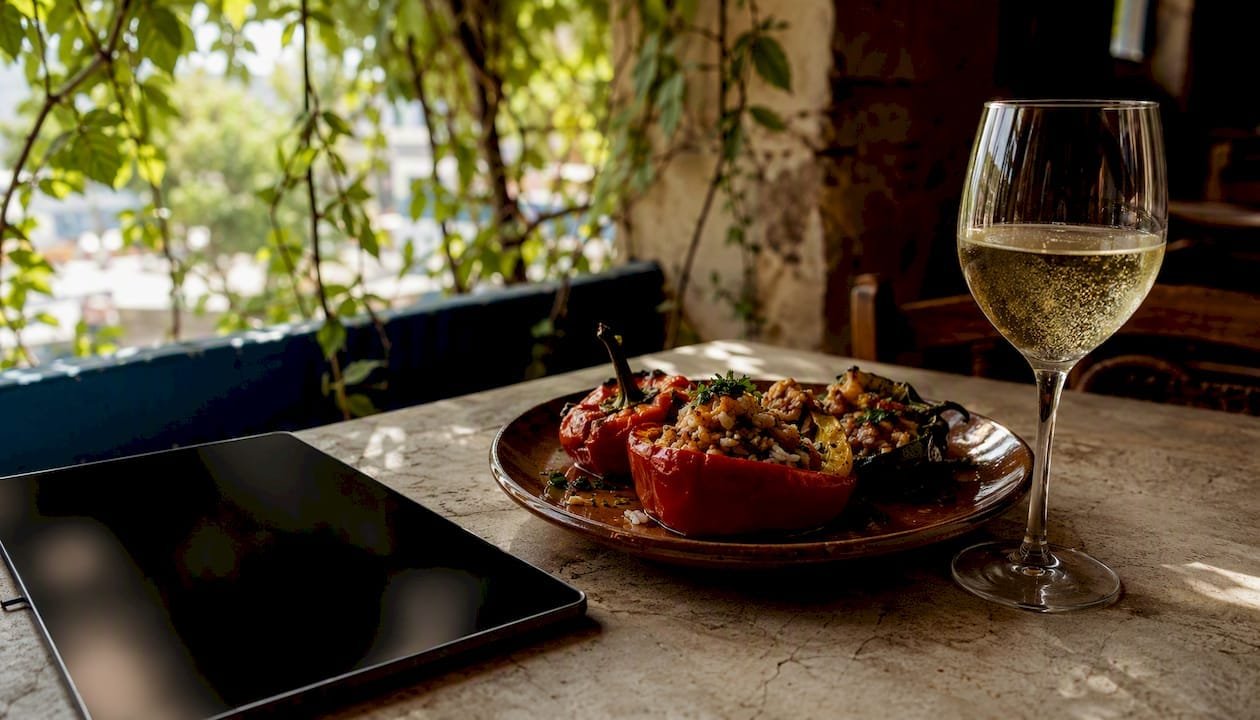
Another common pattern: restaurants near major tourist landmarks that added just two additional languages, chosen from actual guest nationality data rather than guesswork, saw premium item and wine attach rates rise as guests understood descriptions well enough to trust an upsell. A third pattern shows up in allergen handling: restaurants that centralized allergen tags into one master system, rather than translating free text per language, reported far fewer service interruptions from staff needing to double-check ingredients mid-service.
In our own experience running a Mediterranean kitchen where a majority of guests are visiting from outside Spain, the lesson that stuck hardest wasn’t about technology. It was about restraint. A dish name like “pulpo a la gallega” doesn’t need to become “Galician-style octopus with paprika” to sell. It needs one clean line beneath it explaining the preparation, so the name stays authentic and the guest still knows exactly what’s arriving at the table. Readers curious about how menu language shapes perceived authenticity in a Spanish dining context may find our piece on navigating Spanish restaurant menus worth a look.
For the next 30 to 90 days, prioritize:
- Auditing your top 3 guest languages against actual booking or payment data this month.
- Centralizing allergen and dietary tags into one master list before touching any language rollout.
- Piloting a digital menu on a subset of tables before a full switch, so staff and systems are tested under real conditions.
Current industry conversation around menu strategy backs this operational focus; broader gastronomy trend coverage points to guest experience personalization, including language access, as one of the defining operational priorities for kitchens this year.
If you’re weighing how these principles apply beyond translation, whether it’s seasonal menu design or showcasing signature dishes like paella across languages, Kokcha’s own Mediterranean dining pages show how atmospheric dish names and clear functional details can coexist without one undermining the other. A menu built around a flagship dish like meat paella illustrates the principle directly: the name stays true to tradition, while ingredient and allergen information stay unmistakably clear regardless of which language a guest is reading in.
Why Most Restaurants Get Multilingual Menus Backward
Most owners treat multilingual menus as a translation project. It isn’t. It’s an operations project that happens to involve language. The restaurants that get real value out of this don’t start by asking “how do we translate our menu?” They start by asking “where is language currently costing us money?” Usually the answer is buried in comped dishes, slow tables, and servers spending three extra minutes per check explaining a dish that a clear translation could have handled in three seconds.
The conventional advice, hire a translator, print new menus, done, undersells the real work. Translation quality matters, but the research is consistent that perceived quality and cultural authenticity move purchase behavior more than literal accuracy alone. A technically correct translation that reads flat and generic will underperform a slightly looser one that preserves the dish’s character and adds a clear allergen tag beside it.
If there’s one place to focus first, it’s the allergen and modifier data layer, not the language toggle itself. Get that structured and centralized, and every language you add afterward inherits accuracy automatically. Skip that step, and you’re just multiplying the number of places an error can happen. Owners who treat multilingual menus as an infrastructure decision, not a translation task, are the ones who see the check-size lifts and error reductions the research actually documents.
Frequently Asked Questions
What is the role of multilingual menus in a restaurant’s overall strategy?
Multilingual menus reduce order errors, speed up service, and help guests order dishes they’d otherwise avoid out of uncertainty. Operator data links this directly to average-check lifts and fewer kitchen mistakes after launch.
Do multilingual menus really increase sales?
Case data from tourist-area restaurants shows check-size increases in the range of 12 to 23 percent when guests order in their native language, largely driven by higher willingness to try premium dishes and add wine pairings.
Should I use digital or printed multilingual menus?
Digital menus are the better starting point for most restaurants because updates are instant and don’t require reprinting. Printed multilingual menus can work for fine dining rooms with stable, rarely-changing offerings.
How do I keep dish names authentic while translating a menu?
Keep dish names in the host language and translate the functional details around them, ingredients, allergens, and price, into the guest’s language. This preserves cultural identity while giving guests the clarity they need to order confidently.
Should I use AI translation or hire a professional translator?
A hybrid approach works best: use machine translation for a fast first draft, then have someone with culinary and language fluency review it before it goes live on the menu.
What metrics should I track after launching a multilingual menu?
Track order-error rate, average check by language, table turn time, and modifier mismatch incidents. Comparing these against pre-launch baselines shows whether the rollout is actually paying off.
Sources
- Menu language effects on purchase likelihood — Saudi Arabian study (UBJH / University repository)
- Real revenue impact of multilingual menus (Intermenu blog, 2026)
- Quality and strategies in menu translation (DOI: 10.35666/25662880.2019.5.72)