Knowing how to navigate Spanish restaurant menus is the difference between a confident, enjoyable meal and an awkward guessing game at the table. The core distinction every visitor must learn is the difference between el menú (a fixed-price set meal) and la carta (the full à la carte selection), a split that shapes every ordering decision you make in Spain. Beyond that single distinction, understanding how menus are structured by course, what portion terms mean, and which phrases to use transforms reading Spanish menus from a stressful task into a genuine pleasure. This guide covers all of it, from deciphering restaurant menus to ordering with the right words.
How to navigate Spanish restaurant menus: menú del día vs. la carta
The single most disorienting moment for first-time visitors to Spain is sitting down, receiving a menu, and not knowing whether they are looking at a fixed lunch deal or the full restaurant offering. El menú and la carta are two completely different documents, and confusing them leads to ordering the wrong thing at the wrong price.
What is the menú del día?
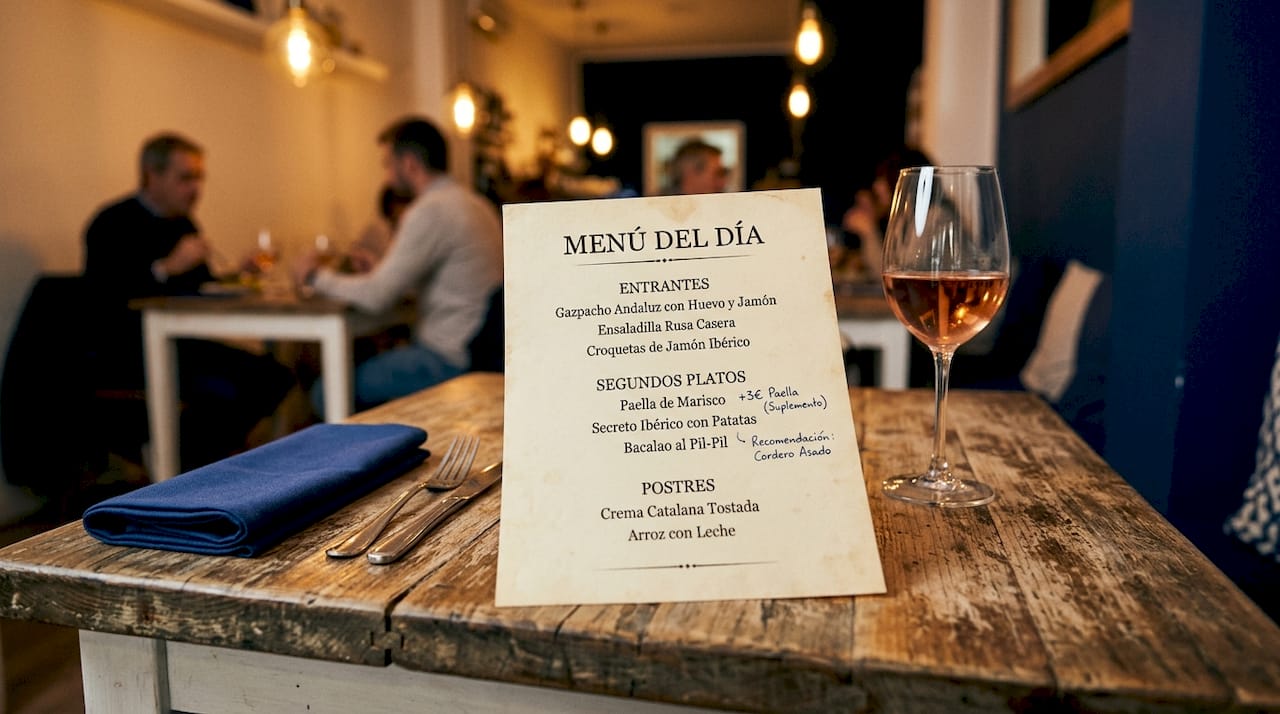
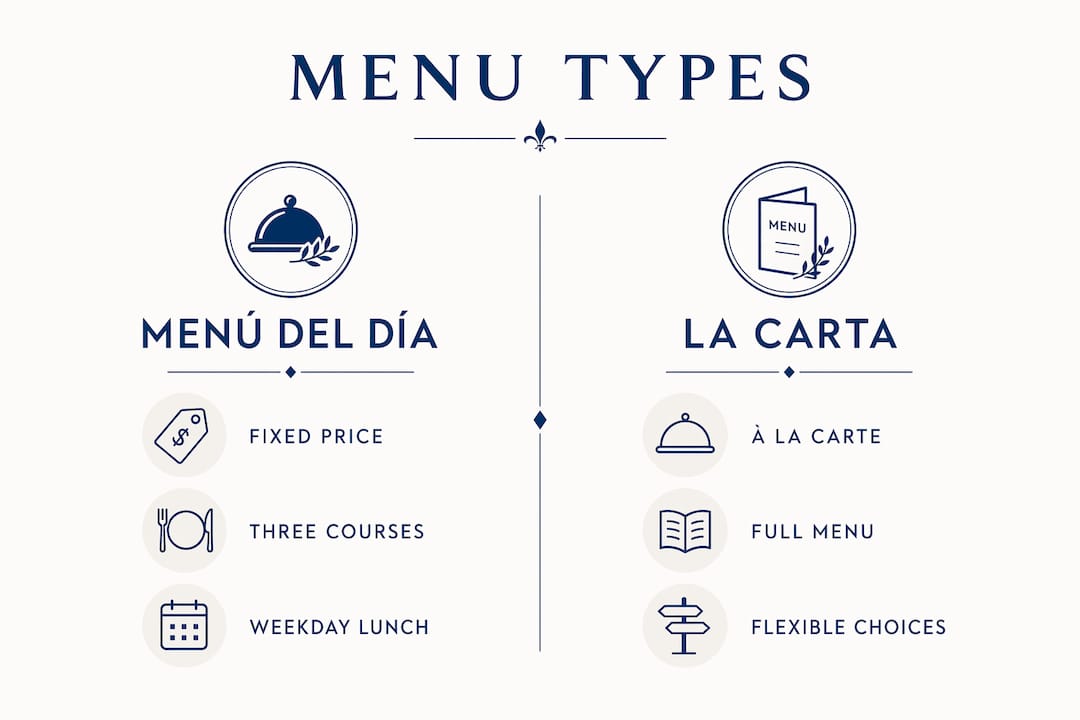
The menú del día is a three-course fixed-price lunch served on weekdays, typically between 1:30pm and 3:30pm, costing around 10 to 16 euros. That price usually covers a starter, a main course, a dessert or coffee, and a drink, often wine or water. This makes it one of the best-value meals in Europe, and locals rely on it heavily. National Geographic notes that the tradition is becoming less common as the restaurant industry changes, which means finding a good menú del día is worth prioritizing when you do.
What is la carta?
La carta is the full à la carte menu, available at lunch and dinner, with individual pricing per dish. This is what most visitors outside Spain expect a restaurant menu to look like. If a server hands you a laminated booklet with prices next to every item, you are looking at la carta.
Common mistakes visitors make:
- Assuming the printed menu handed to them is always the set lunch deal
- Ordering from la carta at lunch without realizing the menú del día exists and is far cheaper
- Asking for “el menú” when they actually want to see the full selection (which requires asking for la carta)
To request the set lunch, say: “¿Tienen menú del día?” To see the full menu, say: “¿Me puede traer la carta, por favor?”
Pro Tip: If you arrive at a restaurant between 1:30pm and 3:30pm on a weekday and want the best value, always ask for the menú del día first. Many restaurants only display it on a chalkboard or recite it verbally, so it will not appear in the printed menu you receive.
What do the sections of a Spanish menu mean?
Once you know which menu you are reading, the next step is understanding how it is organized. Spanish menus follow a clear course structure that mirrors the progression of a full meal, and recognizing each section prevents you from accidentally ordering two mains or skipping a starter you would have loved.
The three core sections are:
- De primero (starters): Soups (sopa), salads (ensalada), cold cuts, or small vegetable dishes. These are lighter and designed to open the meal.
- De segundo (main courses): The heart of the meal. Expect meat (carnes) like cerdo (pork) or ternera (beef), fish (pescados) like merluza (hake) or bacalao (cod), and shellfish (mariscos).
- Postre (desserts): Typically flan, tarta de queso (cheesecake), fresh fruit, or ice cream.
Beyond the course labels, cooking and preparation terms tell you exactly what to expect on the plate:
| Spanish term | Meaning | What it implies |
|---|---|---|
| A la plancha | Grilled on a flat iron | Lean, simple preparation |
| Asado | Roasted | Rich, oven-cooked, often slow |
| Guiso | Stew or braise | Hearty, sauce-heavy dish |
| Frito | Fried | Crispy exterior, often battered |
| Al horno | Baked in the oven | Similar to asado, often with vegetables |
| Crudo | Raw | Uncooked, as in carpaccio or ceviche |
Signature or recommended dishes are often marked with a star, a small icon, or the phrase “especialidad de la casa” (house specialty). When you see that label, it is the kitchen telling you what they do best. Ordering it is almost always the right call.
Regional specialties also appear on menus without explanation. In Catalonia, you will encounter pa amb tomàquet (bread rubbed with tomato) as a starter, and escalivada (roasted vegetables) as a side. In coastal areas, fideuà (a noodle-based dish similar to paella) replaces rice entirely. Knowing these regional markers helps you order dishes that are genuinely local rather than tourist-facing approximations.
Tapa, media ración, ración, or plato: which should you order?
Portion terminology is the hidden math of ordering in Spain. Getting it wrong means either a mountain of food or a plate that disappears in two bites. The four terms you need to know are tapa, media ración, ración, and plato, and they represent a clear size progression.
| Portion term | Approximate size | Best for |
|---|---|---|
| Tapa | 2 to 4 bites | Sampling, snacking, or pairing with drinks |
| Media ración | Half a full portion | One person eating light, or two sharing |
| Ración | Full sharing portion | Two to three people sharing |
| Plato | Standard main course | One person as a full meal |
The cultural practice in Spain is to order several raciones for the table and share them. This is not just a casual preference. It is the standard way a group eats in a Spanish bar or casual restaurant. Ordering one plato each and eating individually is perfectly acceptable, but you will miss the communal rhythm that makes Spanish dining memorable.
- If you are eating solo, a media ración plus a starter is usually enough.
- If you are two people, two or three raciones shared across the table covers a full meal.
- If you are unsure about size, ask the server: “¿Es suficiente para dos personas?” (Is it enough for two people?)
Pricing tracks directly with portion size, so a ración of jamón ibérico will cost significantly more than a tapa of the same product. Regionally, the terminology shifts slightly. In the Basque Country, small bites are called pintxos rather than tapas, and they are typically priced per piece rather than by portion label.
Pro Tip: When ordering tapas or raciones to share, pace yourself. Spanish kitchens send dishes out as they are ready, not all at once. Order two or three items first, then add more once you see how the portions land.
What phrases do you need to order confidently in Spanish?
Language is the final layer of confidence when reading Spanish menus. You do not need fluency. You need about a dozen phrases that cover every real situation at a Spanish restaurant table.
Here are the most useful, organized by situation:
- Requesting the menu: “¿Me puede traer la carta, por favor?” (Can you bring me the menu, please?)
- Asking for the set lunch: “¿Tienen menú del día?” (Do you have a set lunch menu?)
- Asking for a recommendation: “¿Qué me recomienda?” (What do you recommend?) This phrase is culturally expected and respected in Spain. Servers appreciate being asked and will often steer you toward the freshest or best dish of the day.
- Checking ingredients: “¿Este plato lleva [ingrediente]?” (Does this dish contain [ingredient]?)
- Stating an allergy: “Soy alérgico/a a [ingrediente].” (I am allergic to [ingredient].) For allergy safety, always ask direct ingredient questions in Spanish and state allergies plainly. Never rely solely on translation apps for this.
- Ordering a dish: “Voy a tomar el/la [nombre del plato].” (I will have the [dish name].)
- Asking for the bill: “¿Nos puede traer la cuenta, por favor?” (Can you bring us the bill, please?)
- Ordering another round: “¿Nos pone otra ronda?” (Can you bring us another round?)
One phrase to avoid: “¿Puedo tener…?” is a direct translation of “Can I have…” from English and sounds grammatically awkward in Spanish. Use “¿Me pone…?” or “Voy a tomar…” instead. These are the natural expressions a native speaker uses.
For diners managing dietary restrictions, apps like EatFree can filter menus by allergy and preference as a preparation tool before you arrive. Use it to preview a restaurant’s offerings, then confirm specifics with the server in person using the phrases above.
Pro Tip: If your Spanish is limited, write your allergy or dietary restriction on a small card in Spanish before you go out. Handing it to the server is faster and clearer than attempting to pronounce unfamiliar words under pressure.
Key takeaways
Confident dining in Spain requires knowing the difference between el menú and la carta, reading course sections accurately, matching portion terms to your appetite, and using a small set of Spanish phrases to communicate clearly.
| Point | Details |
|---|---|
| Menú del día vs. la carta | Always ask for the set lunch separately; it will not appear in the printed menu. |
| Menu course structure | Primero, segundo, and postre follow a fixed progression; learn cooking terms to know what arrives. |
| Portion sizing | Tapa, media ración, ración, and plato scale upward; match your order to your group size. |
| Key ordering phrases | “¿Qué me recomienda?” and “¿Este plato lleva…?” cover most real-table situations. |
| Allergy communication | State allergies directly in Spanish; never rely on translation apps alone for safety. |
What I have learned from years of eating in Spain
Most visitors overthink the language barrier and underthink the menu structure. In my experience, the biggest source of confusion at a Spanish restaurant is not vocabulary. It is not knowing which document you are holding. Once you understand that el menú and la carta are two separate things with different prices, formats, and timing, everything else clicks into place.
Spanish restaurant staff are genuinely patient with visitors who make an effort. Asking “¿Qué me recomienda?” is not a sign of ignorance. It is an invitation that most servers welcome. I have had some of my best meals in Spain because a server pointed me toward a daily special that never appeared on any printed menu.
The cultural nuance worth internalizing is this: Spanish dining is slow by design. Nobody rushes you. The bill does not arrive until you ask for it. That rhythm is not inefficiency. It is respect for the meal. Visitors who order tapas like a local and lean into that pace consistently report a better experience than those who try to replicate the fast-turnover dining culture of other countries.
One mistake I see repeatedly: ordering everything at once. In Spain, you order in stages. Start with two or three dishes, see how the portions land, and add more. That approach keeps the meal dynamic and prevents the table from being overwhelmed. It also gives you a reason to keep talking to the server, which is where the real local knowledge lives.
— YellowRock
Discover authentic Mediterranean dining at Kokcha in Barcelona
Barcelona is one of the best cities in the world to put these skills into practice, and Kokcha, located steps from the Sagrada Família, is a strong starting point. The restaurant specializes in Mediterranean cuisine, with a menu that spans tapas, paellas, fresh seafood, and grilled meats. Whether you are a first-time visitor testing your new ordering vocabulary or a resident looking for a reliable terrace with quality food, Kokcha offers the kind of menu that rewards confident ordering. Explore the 2026 Mediterranean culinary trends shaping what appears on menus across Barcelona this year, or browse Mediterranean dishes to try for a preview of what to order when you arrive.
FAQ
What is the difference between el menú and la carta?
El menú refers to a fixed-price set meal, typically the menú del día served at lunch, while la carta is the full à la carte menu with individually priced dishes. Confusing the two is the most common ordering mistake visitors make in Spain.
When is the menú del día served?
The menú del día is a weekday lunch tradition, typically served from 1:30pm to 3:30pm and priced between 10 and 16 euros for three courses including a drink. It is not available at dinner.
How do I ask about allergens in a Spanish restaurant?
Use the phrase “¿Este plato lleva ingrediente]?” to ask if a dish contains a specific ingredient, and state “Soy alérgico/a a [ingrediente]” to declare an allergy. [Always ask directly in Spanish rather than relying on translation apps for allergy-related questions.
What does media ración mean on a Spanish menu?
Media ración means half a full portion, typically enough for one person eating light or two people sharing a single item alongside other dishes. It sits between a tapa and a full ración in size, and portion labels scale consistently across most Spanish restaurants.
How do I find regional specialties on a Spanish menu?
Look for the phrase “especialidad de la casa” (house specialty) or ask the server “¿Qué es típico de aquí?” (What is typical here?). Regional dishes like fideuà in coastal Catalonia or Mediterranean small plates in Barcelona often appear without explanation, so asking is the fastest way to find them.