Book a group restaurant as soon as you have a confirmed headcount and a preferred time window. Then lock in the deposit and menu details in writing. That single sequence prevents the most common disasters: losing the date to another party, getting hit with unexpected minimums, and scrambling over allergies the day of the event.
Before you pick up the phone or send an email, do three things:
- Confirm your estimated headcount (even a range like 18–24 works at first contact).
- Agree on a date and at least one backup date.
- Collect dietary restrictions and accessibility needs from your group.
Doing this in order matters. Restaurants size their private rooms, set-menu pricing, and staffing around your numbers. Walking in with vague details slows the process and can cost you the slot.
Key Takeaways
Securing a group restaurant booking comes down to one discipline: prepare your brief before first contact, then get every agreed term in writing before the event.
| Point | Details |
|---|---|
| Confirm headcount early | Give restaurants your maximum expected number; adjust down later if needed. |
| Get deposit terms in writing | Confirm amount, due date, and cancellation charges before any money moves. |
| Collect allergies in advance | Send a complete dietary list to the kitchen at least one week before the event. |
| Reconfirm 24–48 hours out | A quick call locks in staffing, menu, and any last headcount changes. |
| Use Kokcha for Barcelona groups | Kokcha offers set menus, terrace and indoor spaces, bilingual service, and written confirmations for groups near the Sagrada Familia. |
Table of Contents
- How to book a restaurant for groups: what to decide first
- When should you contact the restaurant?
- What questions should you ask before committing?
- What should you get in writing before the event?
- Day-of coordination: how to run the event smoothly
- How to manage allergies and special diets for large groups
- What Kokcha has learned from handling group bookings
- Kokcha makes group bookings straightforward in Barcelona
- Sources
How to book a restaurant for groups: what to decide first
Before you contact a single restaurant, build your organizer’s brief. Restaurants that handle groups well will ask for all of this upfront, and having it ready signals you are a serious, low-friction client.
Core fields to prepare:
- Final or estimated headcount, plus a buffer (book for your maximum, not your minimum).
- Age mix: children under 12, elderly guests, or mobility-impaired attendees all affect seating layout and menu choices.
- Budget per person, including drinks (be honest; it saves time).
- Preferred service format: set menu, buffet, family-style sharing, or plated courses.
- Arrival logistics: self-drive, coach drop-off, public transit, parking needs.
- Accessibility requirements: step-free access, elevator, adapted restrooms.
| Field | What to prepare |
|---|---|
| Date and backup date | Two options at least two weeks apart |
| Headcount | Confirmed minimum + expected maximum |
| Dietary restrictions | Full list per guest, not just “some vegetarians” |
| Budget per person | Food only vs. all-inclusive (drinks, cake, extras) |
| Space preference | Private room, semi-private, terrace, or main floor |
| Arrival method | Coach, car, metro; drop-off point and parking |
Non-obvious items trip up even experienced organizers. Ask yourself whether the kitchen can handle multiple allergens simultaneously, whether you need staggered service for guests arriving at different times, and whether a private room is a hard requirement or just a preference.
If three people cancel last minute, you avoid paying for empty covers. If three more show up, you have room.*
When should you contact the restaurant?
Lead time is the single variable most organizers underestimate. Practical booking guides recommend confirming at least 3–5 days ahead for a regular weekend table, but for groups that window is far too short.
| Group size | Recommended booking window |
|---|---|
| Small groups | Several weeks ahead |
| Medium groups | Several weeks to a couple of months ahead |
| Large groups | Several months ahead |
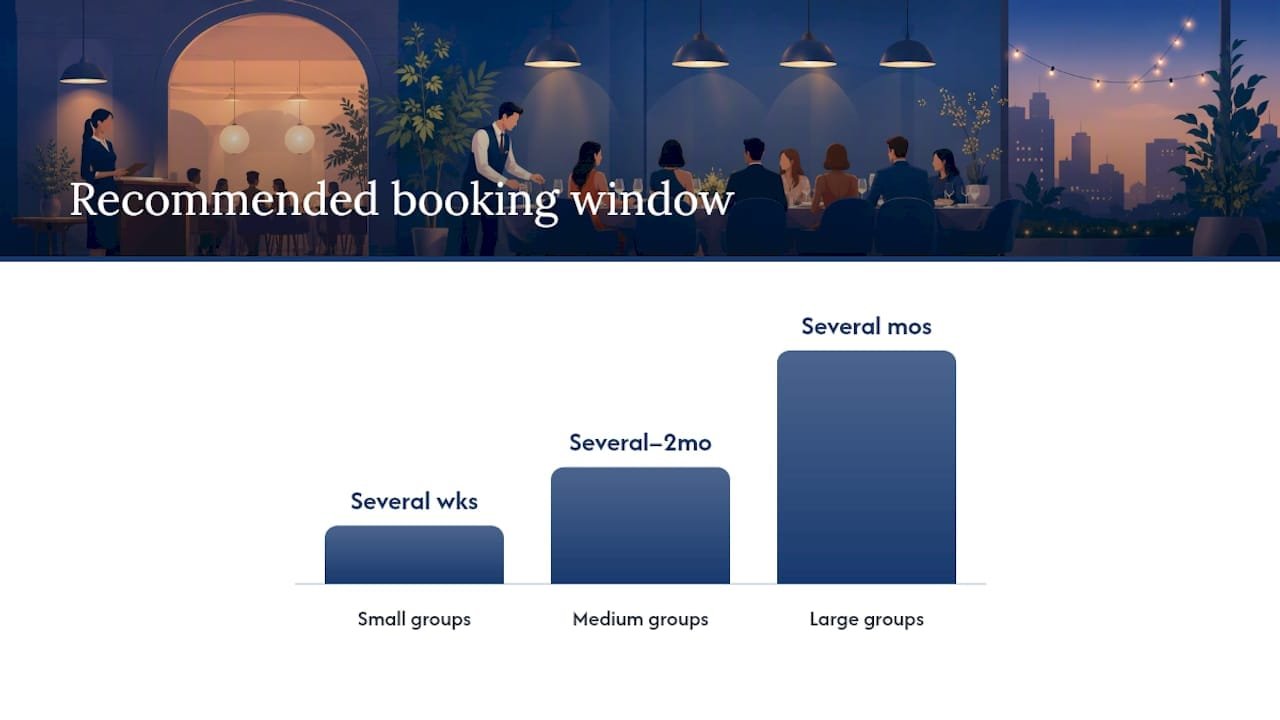
Peak dates (public holidays, summer weekends, Christmas) compress availability fast. For Barcelona specifically, good-weather terrace slots fill weeks earlier than indoor tables. Book earlier than the table above suggests if your date falls in June through September or around a local festival.
Best channels by situation:
- Phone: fastest for checking real-time availability; ask to speak with the events coordinator, not the front-of-house host.
- Email: best for groups of 20+, where you need a written record from the first contact.
- WhatsApp: works well for smaller groups at restaurants that list it as a contact method; less reliable for complex bookings.
- Web booking forms: fine for tables of up to 8–10; most forms cap at that size and route larger requests to a manager anyway.
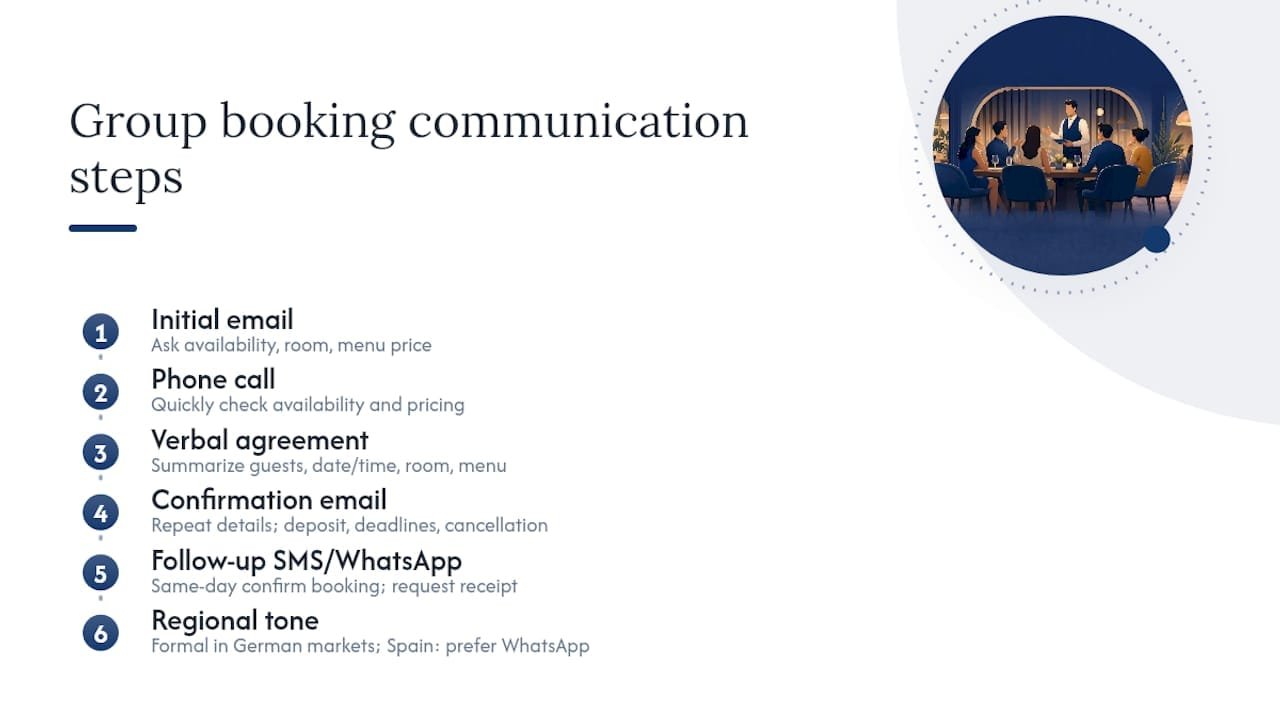
A step-by-step workflow used by professional event planners runs: prepare your brief, contact the restaurant, confirm menu and deposit, get written confirmation, then reconfirm 24–48 hours before the event.
Phone opening script: “Hi, I’m organizing a group of [X] people for [date]. Do you have availability for a group booking, and who should I speak with about menus and a private space?” That gets you to the right person in under 30 seconds.
If the first contact doesn’t respond within 48 hours, escalate to the manager or events coordinator directly. A restaurant that is slow to respond at the inquiry stage is often slow on the day.
What questions should you ask before committing?
Once you have a restaurant interested, shift into evaluation mode. The goal is to confirm fit before any money changes hands.
Negotiation checklist:
- Maximum seated capacity for your preferred space.
- Whether a private or semi-private room is available and whether it costs extra.
- Set-menu options and per-person pricing (ask for a PDF or written quote).
- Children’s menu availability and pricing.
- Drink packages: included, optional, or billed separately.
- Allergen handling: separate prep, dedicated utensils, staff training.
- Minimum spend requirements and what happens if you fall short.
- Coach drop-off access and parking validation.
On menu format, the choice between plated set menus and buffet or family-style service has real consequences for groups. Plated set menus give you predictable per-person costs and faster service; buffets work well for mixed ages and dietary needs but require more floor space. Family-style sharing plates suit Mediterranean dining well and tend to feel more relaxed, though they can slow pacing for larger tables.
For groups above 20, always ask the restaurant to confirm the timing of each course in writing. Larger groups can experience significantly longer meal times if the kitchen isn’t staffed adequately. Ask: “How many covers can your kitchen turn per hour for a set menu?” A confident answer means they’ve done it before.
Off-peak slots (weekday lunches, early Sunday dinners) often unlock better pricing. Ask directly for a closed-menu discount, complimentary welcome drinks, or a reduced minimum spend in exchange for a less popular time slot. Restaurants that specialize in groups often have private rooms, fixed-price group menus, and staff experienced in timed service, which makes negotiation easier and the day smoother.
What should you get in writing before the event?
A verbal agreement is not a booking. Get every term confirmed in a written document, whether that’s a formal contract, a confirmation email, or a signed quote.
Contract checklist:
- Guaranteed cover number and the final-count deadline (typically 5–7 days before the event).
- Deposit amount, payment method, and due date.
- No-show and late-cancellation charges (per person or flat fee).
- How extras are billed: drinks, birthday cakes, AV equipment.
- Room allocation with a description or floor plan.
- Agreed menu with prices, including any substitutions.
- Contact name and mobile number for the day.
| Term | What to confirm |
|---|---|
| Deposit | Amount, due date, refund conditions |
| Final headcount deadline | Date by which you must confirm exact numbers |
| No-show charge | Per-person fee or percentage of total bill |
| Extras billing | Whether drinks, cake, and add-ons are itemized |
| Written confirmation | Email or signed document from the restaurant |
If you need to reduce your headcount after the cut-off, most restaurants will hold you to the guaranteed number. Increasing the count after the cut-off is usually possible but may require a new deposit installment. Clarify both scenarios before signing.
Day-of coordination: how to run the event smoothly
A confirmed booking can still unravel on the day without a clear operational plan.
- Designate one point person from your group who has the restaurant’s direct contact number.
- Confirm arrival window with guests: a 15-minute stagger for large groups prevents a bottleneck at the entrance.
- Verify the table layout matches your brief (private room, accessible seating, high chairs if needed).
- Confirm the payment method with the manager before guests sit down.
- Check that the agreed menu is posted or printed at the table.
Day-of contact card to share with your group:
- Restaurant name and address.
- Manager or events coordinator name.
- Direct mobile number.
- Agreed arrival time and first course time.
For coach arrivals, confirm the drop-off point and any parking restrictions the day before. Accessible arrivals need a clear path from the drop-off to the entrance, which is worth walking yourself if you haven’t visited the venue.
Pro Tip: *Call the restaurant 24–48 hours before the event to confirm staffing, the agreed menu, and any last-minute headcount changes.
How to manage allergies and special diets for large groups
Allergy management for groups is not optional, and for events above a certain size it carries regulatory weight. Collect dietary restrictions from every guest in writing before you contact the restaurant, not after.
Allergy communication template (send to guests):
- “Please list any food allergies, intolerances, or dietary requirements (e.g., gluten-free, nut allergy, vegan, halal, kosher). Include severity for allergies.”
Forward the complete list to the restaurant at least one week before the event. Ask the kitchen to confirm:
- Which dishes are safe for each restriction.
- Whether preparation is separate (dedicated pans, utensils, prep surfaces).
- How cross-contact is avoided during plating and service.
- Whether staff can identify allergen-safe dishes to guests on the day.
For events above 40 guests in Spain, restaurants operating under collective catering rules may be required to retain menu-testigo samples: representative servings of each dish, labeled and dated, kept refrigerated or frozen for at least seven days. This requirement exists to support epidemiological investigation if a food-safety incident occurs. Ask your restaurant whether they follow this practice for your event size.
Pro Tip: Ask the restaurant to stamp or annotate the final printed menu with allergy flags (e.g., “GF,” “V,” “N”) next to each dish, and confirm in writing that the kitchen has reviewed the guest allergy list. That document protects both you and the restaurant.
Copy-ready templates and phone scripts
Use these as starting points and adapt for language or local customs.
Initial availability email:
Subject: Group Booking Inquiry — [Date], [X] Guests
Hi [Restaurant Name],
I’m organizing a group of [X] guests for [date] at approximately [time]. We’re looking for [private room / terrace / main floor] and a set menu around [€XX] per person. Our group includes [any key notes: children, accessibility needs, dietary restrictions]. Could you confirm availability and send your group menu options? Best, [Your Name] / [Phone Number]
Confirmation email (after verbal agreement):
Hi [Name], thanks for confirming our booking. To summarize: [X] guests on [date] at [time], [room/space], [menu name] at [€XX] per person. Deposit of [€XX] due by [date]. Final headcount deadline: [date]. Cancellation policy: [terms]. Please reply to confirm these details are correct.
Phone script for quick calls:
“Hi, I’m calling about a group booking for [X] people on [date]. Can I speak with whoever handles group reservations? I have all the details ready and just need to check availability and pricing.”
Follow-up WhatsApp/SMS (same-day confirmation):
“Hi [Name], just confirming our group of [X] for [date] at [time]. Deposit sent. Please confirm receipt. Thanks, [Your Name].”
For Central Europe, adapt the tone to be slightly more formal in written communication, particularly in German-speaking markets. In Spain, WhatsApp is widely accepted for restaurant communication and often gets faster responses than email.
What Kokcha has learned from handling group bookings
At Kokcha, the group bookings that go smoothly share one thing: the organizer arrived with a brief. Headcount, dietary needs, budget, and a preferred time window in hand. The ones that don’t go smoothly almost always start with “we’re not sure yet how many people.”
The most common mistake we see is organizers treating the deposit conversation as a formality. It isn’t. The deposit locks the room, the staffing, and the menu prep. Skipping that conversation leaves you with a soft hold that disappears the moment a larger group calls.
The templates and checklists in this guide reflect exactly what we ask for at first contact. If you use them, your inquiry will stand out from the majority of group requests we receive, and you’ll get a faster, more detailed response.
For group dining in Barcelona, Kokcha offers bilingual service (Spanish and English), terrace and indoor group spaces near the Sagrada Familia, and a menu built around shared Mediterranean dishes that work well for mixed groups.
Kokcha makes group bookings straightforward in Barcelona
Groups dining near the Sagrada Familia get a concrete advantage at Kokcha: one contact handles everything from menu selection to room allocation, so you’re not bouncing between a reservations line and a kitchen manager.
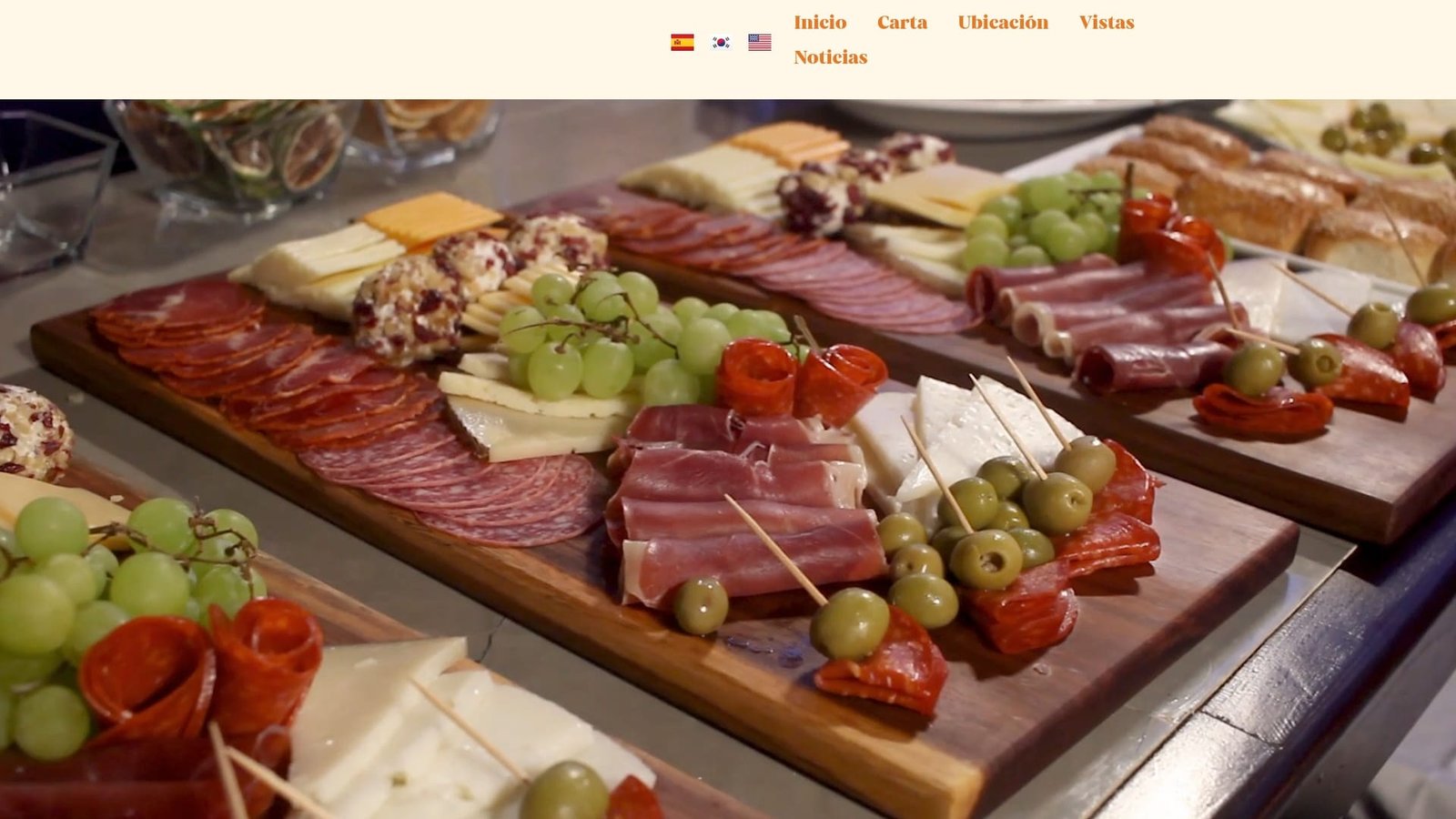
Kokcha’s group offering covers set menus built around Mediterranean sharing dishes, including meat paella and seafood options that scale cleanly for parties of 10 to 50+. The terrace and indoor spaces accommodate different group sizes, and the team handles allergy lists, written confirmations, and deposit terms in both Spanish and English. Coach drop-off coordination and accessible seating are standard parts of the group booking process, not extras you have to negotiate separately.
To start your group booking, contact Kokcha with your date, headcount, and any dietary needs. The team will send a written quote with menu options and deposit terms within 24 hours. Reserve your group table at Kokcha and have your brief ready.
Sources
For anyone who wants to verify the regulatory and practical points in this guide, the sources below are worth bookmarking.
- Menú testigo en restauración colectiva
- Qué tener en cuenta al reservar un restaurante ← Taberna Bolero ®
- Cómo reservar restaurante para celebración paso a paso
Kokcha’s blog also publishes localized how-to articles for booking restaurants in Barcelona, covering seasonal demand, terrace logistics, and group menu planning specific to the city.