Book the right space, confirm the menu and guest count, and give the restaurant clear instructions — then follow the day-of checklist below. That’s the whole plan. Everything else is execution.
Start here (10-minute action checklist):
- Pick 2–3 restaurants that fit your group size and vibe, then call or email today
- Ask about private or semiprivate space, deposit requirements, and cake policy in that first contact
- Collect dietary restrictions from guests before you finalize the menu
- Set a firm RSVP deadline at least one week before the event
- Confirm the final guest count and any pre-orders 48–72 hours before the party
- Designate one person as the day-of contact with the restaurant
Call or email your top choice now — restaurants that respond quickly to group inquiries often secure the booking before a competing date fills the slot.
Key Takeaways
A birthday at a restaurant runs smoothly when you secure the space early, confirm every logistical detail in writing, and give the restaurant one clear point of contact with a final guest count at least 48 hours before the event.
| Point | Details |
|---|---|
| Choose venue by capacity and service model | Match group size to the space; confirm private or semiprivate availability before anything else. |
| Secure the deposit and get terms in writing | Confirm deposit amount, cancellation policy, and minimum spend before you commit. |
| Finalize menu and dietary needs early | Collect restrictions from guests, send the compiled list to the restaurant with your final count. |
| Follow the day-of timeline | Arrive 30–60 minutes early, designate one contact, and time cake or speeches after the main course. |
| Kokcha for Barcelona birthdays | Group menus, terrace views near the Sagrada Familia, and bilingual service simplify the whole process. |
Table of Contents
- How do you choose the right restaurant for a birthday?
- What questions should you ask the restaurant before booking?
- How do reservations, deposits, and confirmations typically work?
- How do you choose a menu and manage dietary needs?
- What can you actually do with decorations, music, and entertainment?
- What does the day-of timeline look like?
- What will the final bill actually include?
- What makes a birthday party actually memorable?
- Why a structured group-booking form saves everyone time
- What a restaurant host actually wants from you
- Kokcha makes birthday bookings straightforward
- Sources
How do you choose the right restaurant for a birthday?
The single most important criterion: the restaurant’s capacity and service model must match your group’s size and energy. A 30-person group in a room designed for 20 will feel crowded and slow down service regardless of how good the food is.
Beyond headcount, look at these factors in roughly this order:
Private or semiprivate space. A dedicated room or a clearly separated section gives your group control over noise, pacing, and decor. Open dining rooms work for small groups of 6–8 but become chaotic for anything larger.
Menu style and service speed. Family-style shared plates work well for casual, mixed-age groups because everyone eats at the same pace and dietary variety is built in. A prix fixe menu suits timed celebrations where you want courses to arrive on a predictable schedule. À la carte works only for small, decisive groups — with 15 or more people, individual ordering slows the kitchen and the table.
Location and accessibility. Choose somewhere within easy reach of most guests, with parking or transit nearby. If older relatives or guests with mobility needs are coming, confirm step-free access before you book.
What to check in photos and reviews. Look for real photos of group setups, not just food shots. Evidence of previous birthday events — decorated tables, group seating arrangements — tells you the restaurant has done this before. Restaurants that publish sample menus with pricing and images of group setups help you answer most questions before you even call. Some venues include basic birthday decoration at no extra cost and recommend booking at least a week in advance, longer during peak seasons. For local options with outdoor space, family celebration restaurants in Barcelona offer a useful reference for what group-friendly setups actually look like.
What questions should you ask the restaurant before booking?
The most important question to ask first: “Do you have availability for [date] for a group of [number], and do you have a private or semiprivate space?” That one question filters out half the candidates immediately.
Once you confirm availability, work through this checklist on the call:
- What is the minimum and maximum capacity for the private space?
- Is there a deposit, and how much? Is it refundable if we cancel?
- Is there a minimum spend or per-person minimum?
- What is the cancellation policy and deadline?
- Can we bring an outside cake? Is there a cake-cutting fee?
- Do you offer a set group menu, and can we see pricing?
- How do you handle food allergies and dietary restrictions?
- Can we arrive early to set up decorations? What is allowed?
- Is there a sound system or AV setup we can use?
- What is the gratuity or service charge policy?
- Is parking available nearby?
Sample booking email you can copy:
Subject: Group Birthday Booking Inquiry — [Date] — [Approx. Guest Count] Guests
Hi [Restaurant Name],
I’m planning a birthday celebration for [date] and would like to inquire about availability for approximately [number] guests.
Could you please confirm:
1. Availability and private/semiprivate space options
2. Group menu options and pricing per person
3. Deposit and cancellation policy
4. Cake policy (outside cake / cutting fee)
5. Decoration rules and setup time
6. How you handle dietary restrictions and allergies
My budget is approximately [amount] per person for food and drinks. Please let me know the best way to proceed.
Thank you,
[Your name and phone number]
How do reservations, deposits, and confirmations typically work?
Confirming the deposit amount and the final guest count deadline are the two actions that protect both you and the restaurant. Everything else flows from those two commitments.
Here is what to expect in a standard group booking:
Deposit. Most restaurants ask for a fixed deposit or a per-person amount to hold the space. This is standard practice — deposits and consumption minimums for larger groups reduce no-shows and protect the venue’s revenue. The deposit is typically applied to the final bill. Ask whether it is refundable and under what conditions.
Minimum spend vs. room rental. Many restaurants prefer a per-person consumption minimum over a flat room-rental fee because it feels more natural to guests. Both accomplish the same thing: they guarantee the restaurant a floor on revenue for holding the space. A consumption minimum is often negotiable; a room rental usually is not.
Cancellation policy. Get this in writing. Common terms: full refund if canceled 7–14 days out, partial refund within 48–72 hours, no refund for same-day cancellations. Know the policy before you sign.
Final guest count deadline. Restaurants typically need a confirmed headcount 48–72 hours before the event to prepare staffing, food quantities, and seating. Missing this deadline can result in delays or extra charges.
Practical timeline:
- 3–6 weeks before: pay deposit, confirm space and date
- 1–2 weeks before: send final menu selections and any pre-orders
- 48–72 hours before: confirm final guest count and any last dietary changes
- Day before: confirm arrival time and point of contact with the restaurant
Restaurants that publish clear group policies — capacity, sample menus, deposit terms — make this process faster for everyone. If a restaurant can’t tell you its deposit policy clearly, that’s a warning sign. For a step-by-step walkthrough of the booking process itself, how to book a restaurant for groups covers the key fields and deposit language in detail.
How do you choose a menu and manage dietary needs?
For most birthday groups, a small prix fixe or shared-plates format is the right call. It reduces kitchen delay, makes cost predictable, and lets you pre-check dietary needs before the day.
| Menu Format | Service Speed | Cost Predictability | Allergy Management |
|---|---|---|---|
| Set prix fixe | Fast — courses arrive together | High — fixed price per person | Easy — confirm substitutions in advance |
| Family-style / shared plates | Moderate — dishes arrive as ready | Moderate — set per-table price | Good — variety covers most needs |
| À la carte | Slow for large groups | Low — wide variation per guest | Harder — individual orders increase error risk |
A professional group proposal typically includes multiple menu levels — basic, standard, and premium — along with drink package options. Ask for this when you inquire. It makes budgeting much easier than negotiating dish by dish.
Collecting dietary information from guests:
- Send a simple RSVP form that includes a dietary restrictions field (vegetarian, vegan, gluten-free, nut allergy, shellfish allergy, other)
- Set a reply deadline at least 5 days before the event
- Compile the list and send it to the restaurant at the same time you confirm the final guest count
- For severe allergies (anaphylactic), call the restaurant directly and speak to the chef or manager — do not rely on a written note alone
Children’s menus are worth asking about specifically. Many restaurants offer a simplified version of the group menu for younger guests, but it is rarely listed on the standard group inquiry form. If you have kids coming, ask.
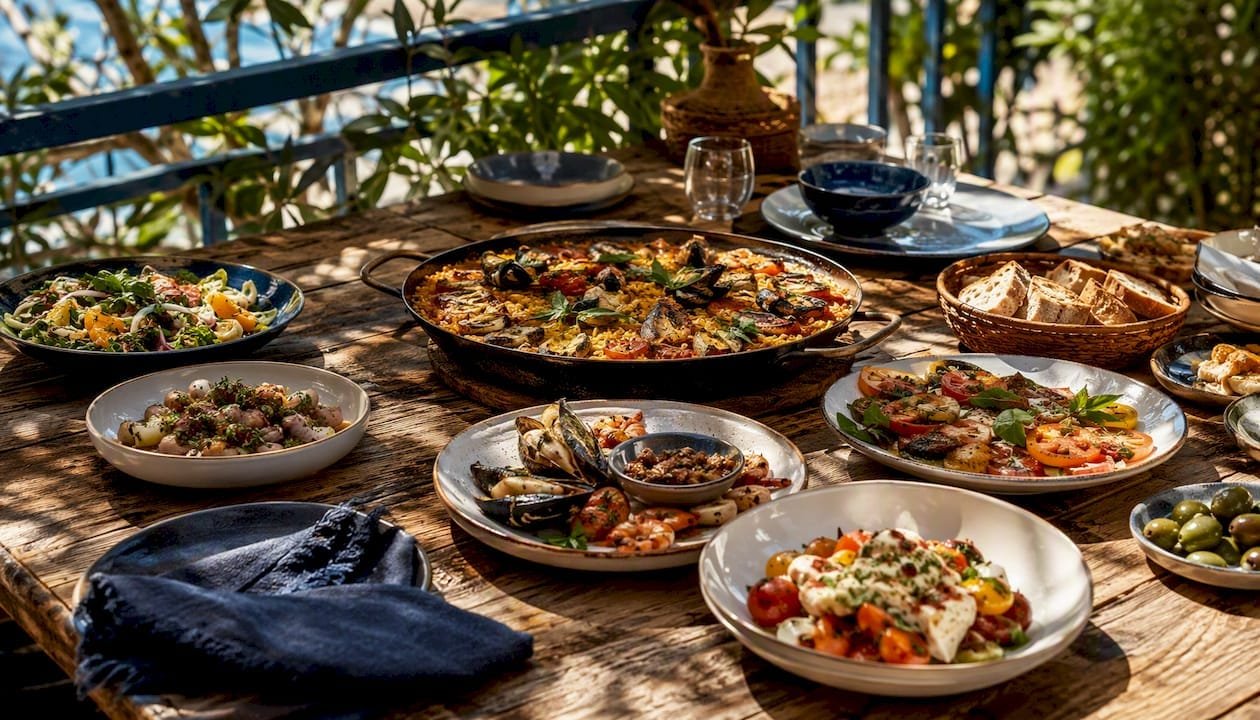
For groups with several vegetarian or vegan guests, vegetable paella and other plant-based shared dishes can anchor the menu without requiring a separate order track. For a practical guide to choosing shared dishes for groups, how to choose paella for events covers the format well.
What can you actually do with decorations, music, and entertainment?
Confirm the rules before you bring anything. Most restaurants allow small tabletop decor and simple banners; most draw the line at confetti, large balloon arches, or external entertainers who require setup time or sound equipment.
Commonly allowed:
- Tabletop candles (battery-powered if open flame is restricted)
- Small balloon clusters tied to chairs or a centerpiece
- A printed banner or sign (ask about tape on walls)
- Printed menu cards or table name cards
- A small photo area with a freestanding backdrop
Commonly restricted or banned:
- Loose confetti or glitter (cleanup cost is real and staff resent it)
- Large balloon installations that block sight lines or exits
- External DJs or live bands without prior approval
- Fog machines, sparklers, or pyrotechnics
- Hanging decorations from ceiling fixtures
Communicating setup expectations clearly in advance — whether cake cutting is allowed, what decorations are permitted — avoids last-minute conflicts and lets the restaurant plan staffing around your arrival.
Smart workarounds: Battery-powered fairy lights in a small vase create ambiance without any fire risk. A pre-arranged dessert presentation (the restaurant brings out a decorated cake with candles already lit) is more reliable than trying to coordinate it yourself mid-service. Table cards with a short note about the guest of honor add a personal touch that costs almost nothing.
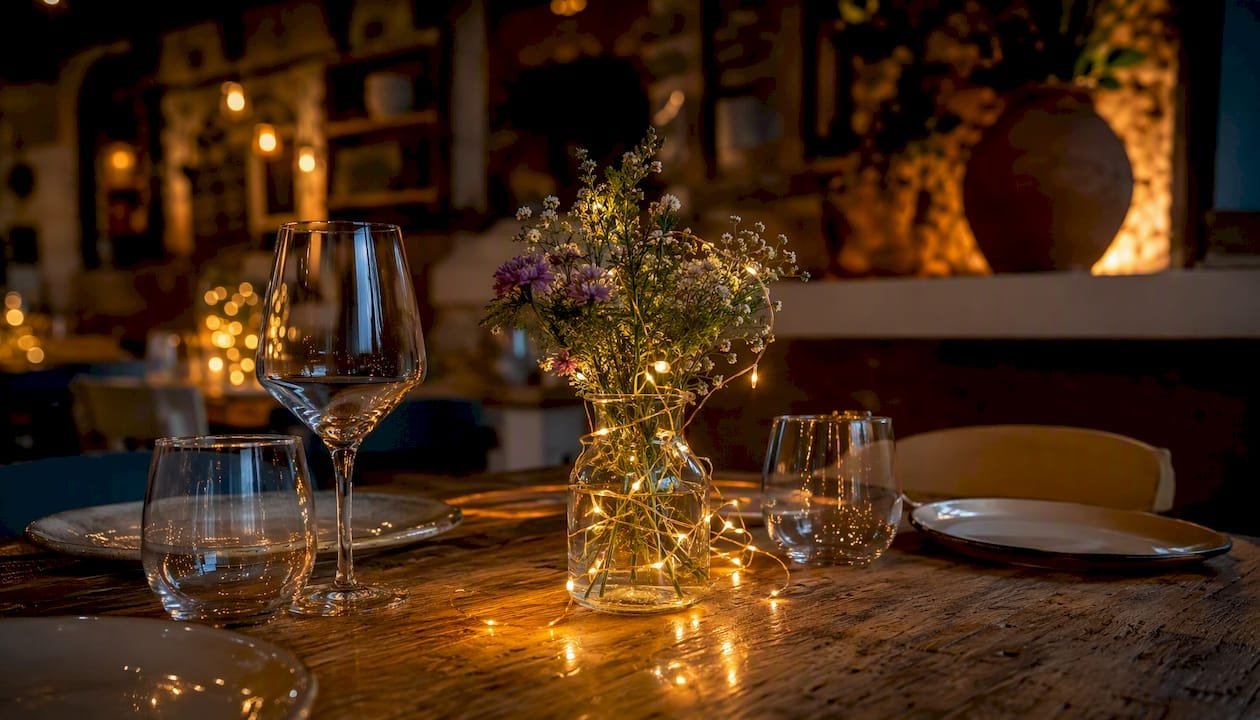
Ask for a 20–30 minute setup window before guests arrive. Most restaurants will accommodate this if you ask at booking, not on the day.
What does the day-of timeline look like?
Arrive 30–60 minutes before your guests and have one named point of contact with the restaurant. That single habit prevents more problems than any other preparation.
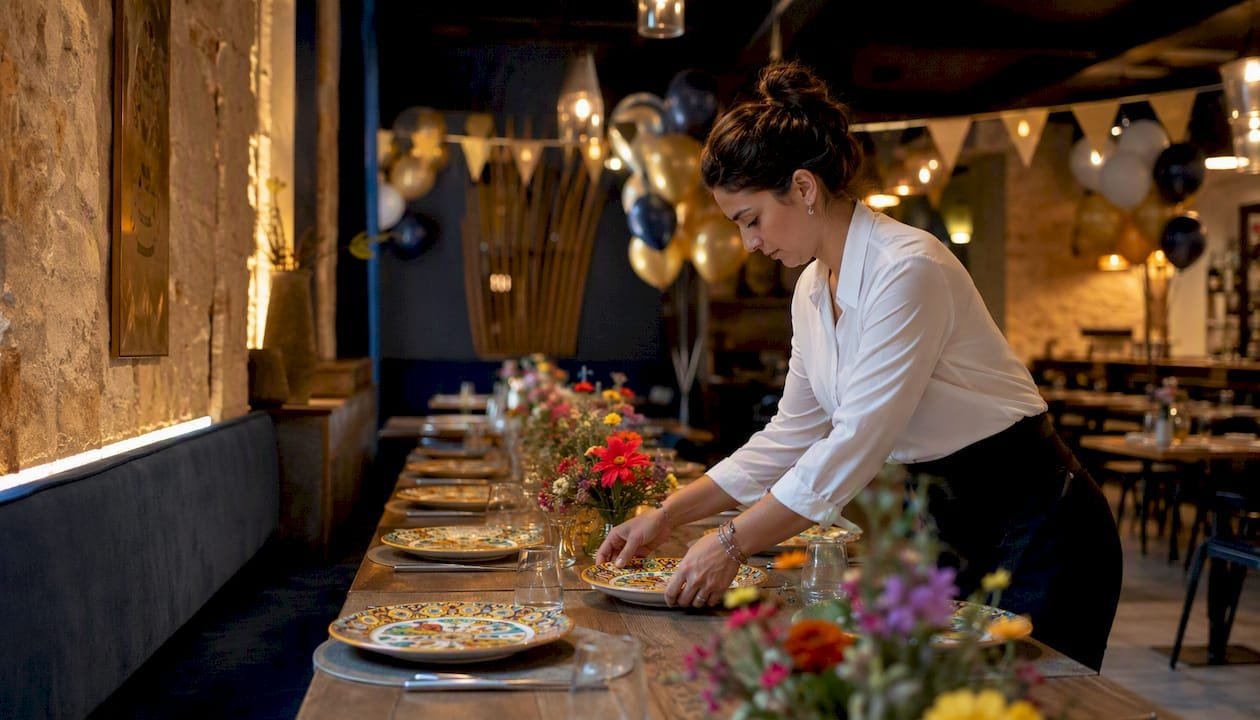
Arrival (T-45 minutes): Meet your restaurant contact, confirm the table layout, check that any pre-arranged decor is in place, and do a quick walk-through of the space. Confirm where the cake is being stored and when it will come out.
Guest arrival window (T-0 to T+20 minutes): Greet guests at the entrance or designate someone to do it. Have a welcome drink or aperitif ready so early arrivals aren’t waiting with nothing.
Main service (T+20 to T+90 minutes): Let the kitchen set the pace. If courses are running slow, quietly check with your restaurant contact rather than flagging it loudly. For speeches, the best window is after the main course and before dessert — guests are relaxed, the table is clear, and the kitchen has a natural pause.
Cake and photos (T+90 to T+110 minutes): Coordinate the cake arrival with your contact at least 15 minutes before you want it. Designate one person to handle the group photo — trying to organize it spontaneously wastes 10 minutes.
Wrap-up (T+120 minutes): Thank the staff directly. Confirm the final bill matches what was agreed, check that the service charge is included so you’re not double-tipping, and collect any personal items or leftover decor.
Quick contingencies:
- Guest cancellations after the final count: inform the restaurant as early as possible; most will adjust the bill if notified before service starts
- Late food: ask your contact privately, not in front of guests
- Table layout issues: flag them on arrival, not after guests are seated
A structured event checklist sent to the venue 3–5 days before the event — covering timeline, contact, menu, allergies, and AV needs — reduces day-of surprises significantly.
What will the final bill actually include?
The final bill for a group birthday commonly includes food, drinks, service charge or gratuity, taxes, and extras like a cake-cutting fee, corkage, or a private-room surcharge. The surprises almost always come from the last category.
Common cost components:
- Food: set menu price per person or à la carte total
- Drinks: consumption-based or a pre-agreed beverage package
- Service charge: typically 10–15% added automatically for groups; confirm whether it is included in the quoted price or added on top
- Taxes: VAT or local equivalent, usually included in menu prices but worth confirming
- Cake-cutting fee: charged per person or as a flat fee when you bring an outside cake
- Corkage fee: if you bring your own wine
- Private room surcharge: sometimes waived if you meet the minimum spend
Negotiation levers that actually work:
Ask for a per-person all-inclusive package that bundles food, a drink allowance, and service charge. This is easier to budget and often cheaper than paying each line item separately. A consumption minimum is often more acceptable to guests than a room rental fee, and many restaurants will negotiate the minimum if your group is large enough. Set a drink package with a clear per-person limit rather than an open tab — it prevents bill shock and makes the final reconciliation fast. Always request an itemized bill at the end, not a single total.
What makes a birthday party actually memorable?
A few personal touches create the memory. Pick one or two to focus on rather than trying to do everything.
A meaningful toast. Assign someone to give a short, specific toast — two minutes, one story, one wish. It costs nothing and is the moment guests remember most.
A surprise dessert presentation. Coordinate with the restaurant to bring out a decorated cake or dessert plate with a candle while the staff dims the lights briefly. Pre-arrange this at booking so it doesn’t catch the kitchen off guard.
Printed menu or table cards. A simple card with the guest of honor’s name and a short note about the occasion makes the table feel intentional. Print them at home or order them online for a few dollars.
A group photo plan. Decide in advance where the photo will happen (at the table, outside the entrance, on a terrace) and who will take it. Spontaneous group photos at restaurants almost always end with someone missing or a blurry shot.
A personal playlist. If the restaurant allows it, share a short playlist with the staff in advance. Even 30 minutes of music the birthday person loves changes the atmosphere.
For more ideas on making a special dinner feel distinct, tips for a special dinner in Barcelona covers the small touches that shift a meal from ordinary to memorable.
Pro Tip: Time the cake or the main toast right after the main course is cleared. The kitchen has a natural pause, guests are satisfied but not yet restless, and the moment lands better than it does mid-meal or at the very end when people are thinking about leaving.
Why a structured group-booking form saves everyone time
Using a structured group-booking form for event inquiries reduces back-and-forth and helps restaurants and hosts align details from the first contact. Industry professionals treat group bookings with event-level rigor: dedicated inquiry forms let staff gather structured data from the start, cutting admin time on both sides.
Here are the key fields every group-booking form should include:
Restaurants that build a dedicated group-reservations page with clear fields convert more inquiries because organizers get concrete answers fast. You can use the same logic in reverse: send a pre-filled version of this form with your inquiry email, and you’ll get a faster, more accurate response.
Sample form you can paste into an email:
Name: [Your name]
Contact: [Phone / email]
Date and time: [Date, preferred start time]
Guest count: [Minimum] to [Maximum]
Budget per person: [Amount, food and drinks]
Menu preference: [Set menu / shared plates / flexible]
Dietary restrictions: [List all known restrictions]
Special requests: [Outside cake, decorations, AV, early setup]
Questions: [Deposit policy, cancellation terms, anything else]
Send this with your initial inquiry and you’ll typically cut the back-and-forth by two or three exchanges.
What a restaurant host actually wants from you
Clear guest count, known allergies, and one point of contact — those three things make the difference between a smooth event and a stressful one. When a host arrives with a vague headcount (“somewhere between 15 and 25”), no dietary information, and three different people calling to ask questions, the kitchen and floor staff are managing uncertainty instead of managing service.
What experienced hosts recommend:
- Confirm your final guest count in writing 48 hours before the event, not on the day
- Send the allergy list as a separate, clearly labeled document — not buried in a long email
- Designate one person as the single point of contact and give the restaurant that person’s phone number at booking
- Inform the restaurant it’s a birthday at the time of booking, not when you arrive — proactive communication at booking allows staff to assign better tables or prepare small touches that would be impossible to arrange last-minute
- Tidy up small gift-wrapping debris and avoid confetti; leaving the space reasonably tidy helps with table turnover and keeps goodwill with the staff
The hosts who get the best service are almost always the ones who made the restaurant’s job easy from the first inquiry.
Kokcha makes birthday bookings straightforward
Planning a birthday dinner near the Sagrada Familia? Kokcha handles the parts that usually cause the most friction: group menus, dietary variety, and bilingual service for mixed international and local groups.
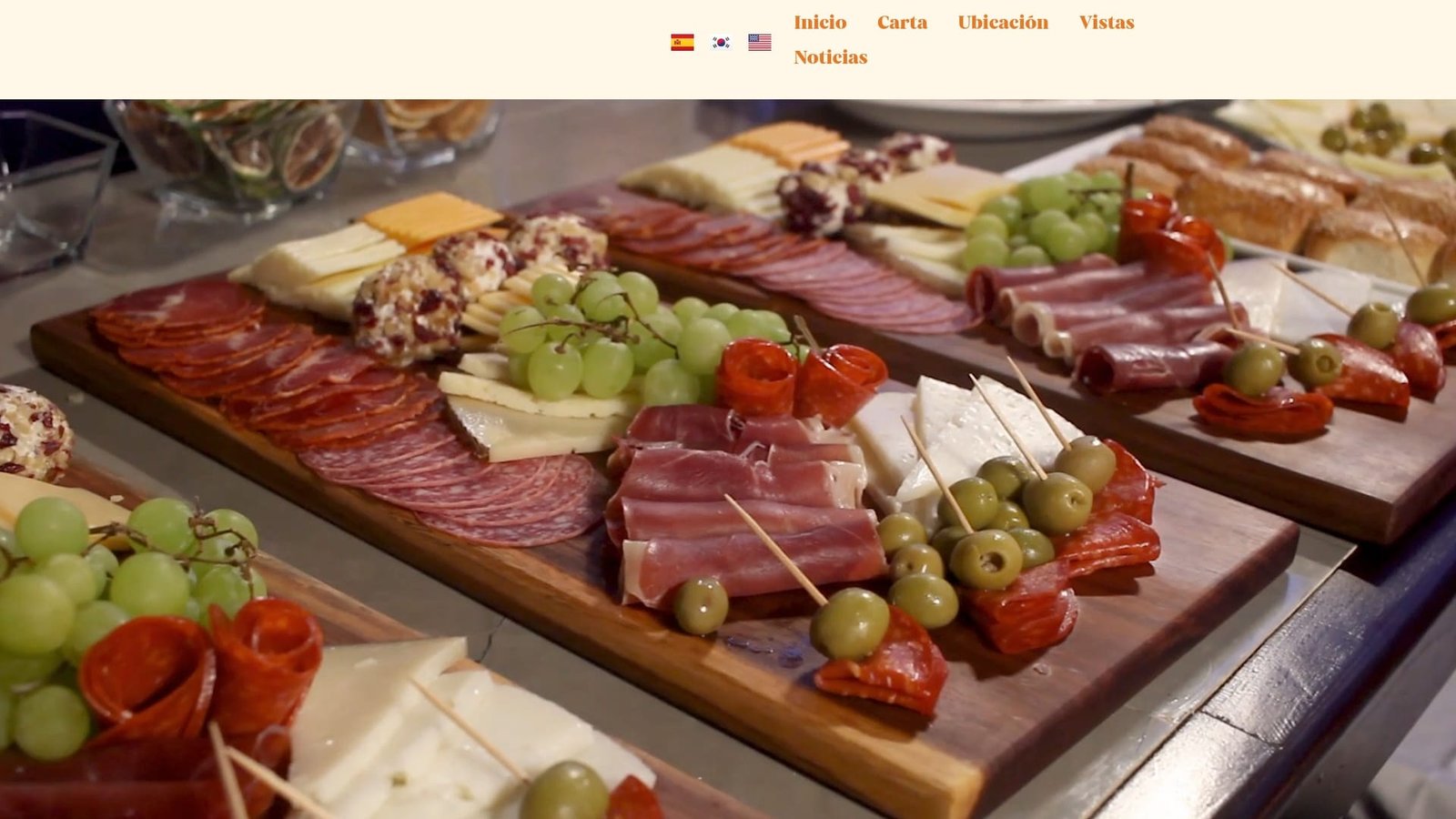
The menu covers enough ground to satisfy most groups without negotiation — meat paella, seafood paella, and chicken paella work well as shared centerpieces, with tapas, grilled meats, pasta, and salads rounding out the options for guests with different preferences. The terrace with views of the Sagrada Familia gives the celebration a setting that does a lot of the work for you. For event planners looking at broader menu package inspiration, festive meal offerings for 2026 are worth a look alongside Kokcha’s own group options.
Availability fills up, especially on weekends and during peak tourist season. Check dates and send your group inquiry at Kokcha to confirm your booking before the slot goes.
Sources
The resources below cover the key stages of planning a restaurant birthday, from initial inquiry to day-of execution.
- Cómo Ganar Reservas de Grupos Grandes
- Reservas de Grupo: 7 Pasos hacia Eventos Impecables (Guía 2026) | HappyChef
- Pasos para organizar evento en restaurante con éxito
- Conquista las reservas de grupos grandes y dispara tus ingresos – Software para Restaurantes 🚀 | COVERMANAGER