Spain produces six main types of wine: still reds, still whites, rosés, sparkling (Cava), fortified (Sherry/Jerez), and sweet or dessert wines. Each bottle also carries an ageing signal you can read at a glance:
- Still reds range from light, fruit-forward Joven to deeply structured Gran Reserva; Tempranillo and Garnacha dominate.
- Still whites split between crisp aromatic styles (Albariño, Verdejo) and richer barrel-influenced versions.
- Rosés are typically dry and pale, especially from Garnacha in Navarra and Rioja.
- Cava is Spain’s traditional-method sparkling wine, produced mainly in Penedès.
- Sherry (Jerez) covers everything from bone-dry Fino to rich, sweet Pedro Ximénez.
- Sweet and dessert wines include botrytized styles and fortified Moscatel.
- Ageing labels: Joven (no oak requirement) is your go-to for fresh, immediate drinking. Crianza, Reserva, and Gran Reserva signal increasing time in oak and bottle. When you want something to open tonight, look for Joven or Roble. When you’re buying to age or impress, reach for Reserva or Gran Reserva from a recognized DO.
Key Takeaways
Spain’s six wine styles, combined with its ageing label system and regional grape identities, give you a reliable framework for choosing any bottle with confidence.
| Point | Details |
|---|---|
| Six core styles | Still red, white, rosé, Cava, Sherry, and sweet wines each signal a distinct flavor and production approach. |
| Ageing labels signal style, not rank | Crianza, Reserva, and Gran Reserva indicate time in oak and bottle; a great Joven can outperform a mediocre Gran Reserva. |
| Region narrows the grape | Albariño means Rías Baixas; Tempranillo means Rioja or Ribera del Duero; Monastrell means Jumilla or Yecla. |
| Regional rules override national floors | Rioja DOCa requires 12 months in oak for Crianza and 24 months for Gran Reserva, stricter than the national minimums. |
| Central European buying tip | Crianza offers the best value entry point (roughly €10–18); Fino Sherry is chronically underpriced at €10–15 for quality bottles. |
Table of Contents
- What are the main types of Spanish wines and how do they taste?
- How does Spain’s wine classification and ageing system work?
- Which Spanish wine regions should you know?
- What do Spain’s key grape varieties taste like?
- What makes Sherry, Cava, and Spain’s specialty wines unique?
- How do you choose and buy Spanish wine in Central Europe?
- Kokcha’s pairing perspective: Spanish wines with tapas and paella
- Why Spanish wines offer exceptional value and stylistic range
- Sources
What are the main types of Spanish wines and how do they taste?
Spain’s still reds are the country’s commercial backbone. According to the Spanish Ministry of Agriculture’s 2023/24 IGP report, red wine accounts for roughly 58.65% of total commercialized volume and about 60.62% of export volume. That dominance reflects both domestic preference and international demand, particularly for Rioja and Ribera del Duero. Lighter reds from Mencía or young Garnacha taste closer to a Pinot Noir in weight; a Gran Reserva Tempranillo from Rioja sits in full-bodied, tannic territory with cedar, dried cherry, and vanilla from extended oak.
Spanish whites divide sharply by style. Albariño from Rías Baixas and Verdejo from Rueda are aromatic, high-acid, and meant to be drunk young. Barrel-fermented Viura blends from Rioja or aged Rueda Verdejo are richer, with toasty notes and more texture. Rosés, called rosado, are almost always dry; Garnacha-based versions from Navarra tend toward strawberry and watermelon with a clean finish.
Cava uses the same production method as Champagne (secondary fermentation in bottle), but relies on native grapes: Macabeo, Xarel·lo, and Parellada. The result is typically earthier and more yeasty than Champagne, with green apple and brioche character. Brut Nature Cava carries no added sugar, making it one of the driest sparkling wines you can find at its price point.
Sherry is the most misunderstood category. Fino and Manzanilla are pale, saline, and almost shockingly dry. Amontillado sits in the middle: nutty, amber, and complex. Oloroso is dark and walnut-rich without sweetness. Pedro Ximénez (PX) is the opposite extreme, a near-syrup of dried figs and raisins that works as a dessert on its own.
How does Spain’s wine classification and ageing system work?
Spain’s quality pyramid runs from the broadest to the most specific. At the base sits Vino de España (table wine with no geographic restriction), then Vino de la Tierra (VT) or IGP (Indicación Geográfica Protegida) for regional wines, then Vino de Calidad con Indicación Geográfica (VC), then DO (Denominación de Origen), and at the top, DOCa (Denominación de Origen Calificada). Only Rioja and Priorat currently hold DOCa status. Above all of these sits Vino de Pago, a single-estate designation for estates that demonstrate consistent, distinctive terroir under strict on-site production rules. The Wine Scholar Guild’s overview of Spain’s quality system explains how each tier controls authorized varieties, production methods, and geographic limits.
The Spanish Ministry of Agriculture publishes the official registry of DOPs and IGPs, which also documents labeling substitutions. A bottle may legally use “DOP,” “DO,” or “DOCa” interchangeably depending on the producer’s preference, which is why you’ll see both on shelves. According to El Paladar’s overview of Spanish appellations, Spain has roughly 101 DOPs and 43 IGPs, a breadth that reflects the country’s extraordinary geographic and climatic diversity.
National ageing minima for red wines
The Spanish Wine Authority sets out the legal national floors:
| Category | Total ageing | Minimum in oak | Minimum in bottle |
|---|---|---|---|
| Joven | No minimum | None required | None required |
| Crianza | 24 months | 6 months | Remainder |
| Reserva | 24 months | 12 months | Remainder |
| Gran Reserva | 60 months | 18 months | 24 months |
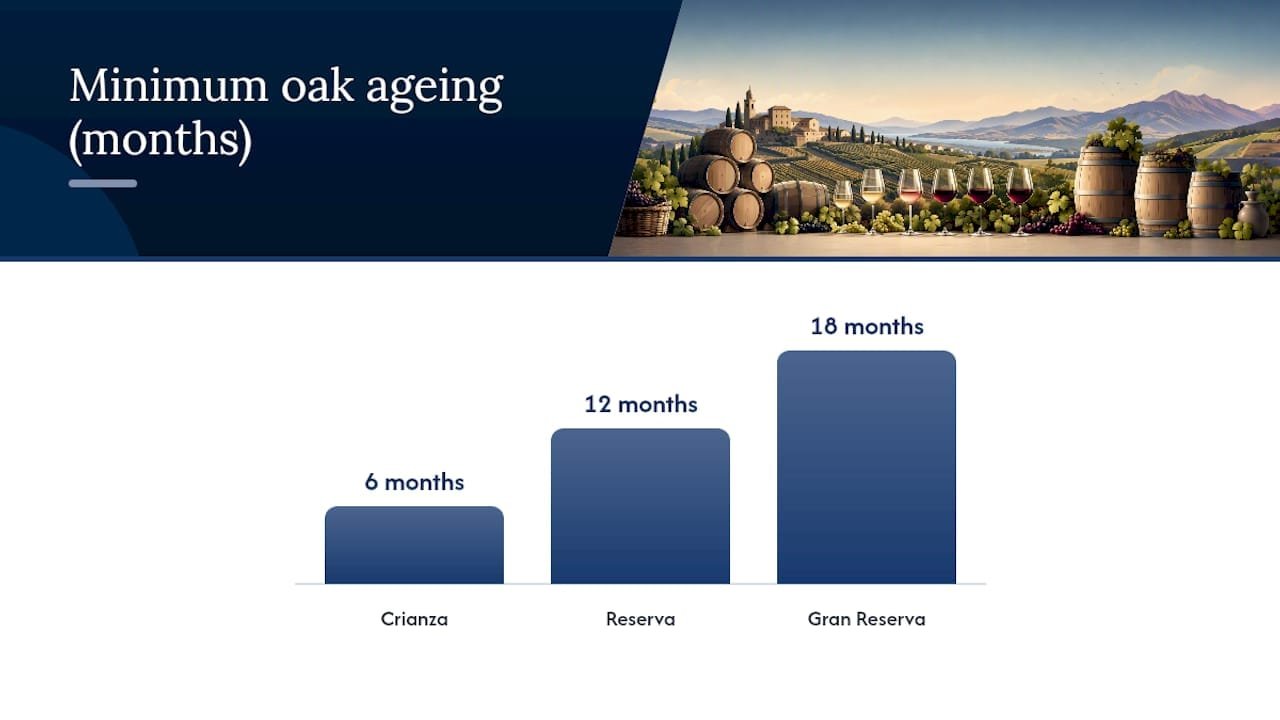
Regional DOs can and do raise these floors. Rioja DOCa requires 12 months in oak for Crianza and 24 months in oak for Gran Reserva, both exceeding the national minimums. That stricter standard is part of why Rioja Reserva and Gran Reserva have a distinctive vanilla-and-spice oak signature that bottles from other regions at the same ageing category may not share.
One thing worth understanding: ageing categories are stylistic markers, not quality rankings. A well-made Joven from a top producer can outperform a mediocre Gran Reserva. The label tells you about time spent in wood and bottle; it says nothing about the quality of the fruit that went in.
Pro Tip: When comparing bottles from different DOs, always check the Consejo Regulador (the DO’s governing council) for region-specific oak minima. Rioja’s rules and those of, say, Ribera del Duero are not identical, so a Crianza from each region represents a different amount of oak time.
Which Spanish wine regions should you know?
Spain’s wine map is one of the most varied in the world. Here’s what each major region actually delivers:
-
Rioja (DOCa): The benchmark for Spanish red wine. Tempranillo-dominant, often blended with Garnacha, Mazuelo, or Graciano. The region’s oak tradition produces wines with pronounced vanilla, dried cherry, and leather. Pair Rioja Crianza with lamb chops or roast chicken; Reserva with aged Manchego.
-
Ribera del Duero (DO): Higher altitude than Rioja (roughly 850 meters), which means cooler nights and more concentrated, darker-fruited Tempranillo (called Tinto Fino here). Wines tend toward blackberry, graphite, and firm tannins. Pair with grilled beef or roast suckling pig.
-
Priorat (DOCa): Spain’s other DOCa. Old-vine Garnacha and Cariñena grown in llicorella (slate and quartz soils) produce wines of extraordinary mineral intensity and high alcohol. These are not everyday bottles; they reward decanting and pair with rich stews or aged hard cheeses.
-
Rías Baixas (DO): The home of Albariño. Atlantic-influenced, granite soils, and high rainfall produce Spain’s most aromatic whites: peach, citrus, and a saline edge. The natural pairing is Spanish-style seafood and shellfish.
-
Rueda (DO): Verdejo country on the Castilian plateau. Wines are grassy, citrusy, and refreshing with a slightly bitter almond finish. Barrel-fermented versions add weight and complexity. Pair with white fish, goat cheese, or vegetable dishes.
-
Jerez/Sherry (DO): Fortified wines made from Palomino (for dry styles) and Pedro Ximénez or Moscatel (for sweet). The albariza chalk soils and Atlantic breezes create conditions found nowhere else. Fino with jamón ibérico; Oloroso with walnuts and aged cheese; PX poured over vanilla ice cream.
-
Penedès/Cava (DO): Cava’s heartland, though the DO now spans several regions. Macabeo, Xarel·lo, and Parellada are the classic blend; Chardonnay and Pinot Noir appear in premium Cava. Brut and Brut Nature styles work well as aperitifs or with fried tapas.
-
Toro (DO): Tinta de Toro (a local Tempranillo clone) grown at altitude produces dense, powerful reds with dark plum and earthy notes. Toro wines punch above their price point and age well. Pair with braised meats or hearty bean stews.
-
Jumilla/Yecla (DO): Monastrell territory in the hot Levante interior. Wines are full-bodied, inky, and spiced with dark berry and pepper. They handle bold food well: barbecue, spiced lamb, or strong cheeses.
What do Spain’s key grape varieties taste like?
Tempranillo is Spain’s flagship red grape. It delivers medium-to-full body, moderate acidity, and flavors of red cherry, tobacco, and dried herbs. In Rioja it takes on vanilla and coconut from American oak; in Ribera del Duero it reads darker and more mineral. Pair with grilled meats, lamb, or tapas like chorizo and morcilla.
Garnacha (Grenache) is more fruit-forward and lower in tannin: raspberry, red plum, and a warm, spicy finish. It thrives in Priorat (where it becomes something else entirely in old-vine form), in Garnacha rosés from Navarra, and in the Campo de Borja DO. Pair with roasted vegetables, duck, or spiced pork.
Monastrell (Mourvèdre) dominates Jumilla and Yecla. Expect blackberry, licorice, and a meaty, savory edge. High alcohol is common. It handles bold, fatty dishes well and stands up to heavily spiced food.
Mencía grows in Bierzo and Ribeira Sacra, often on dramatic slate terraces. It’s lighter and more aromatic than Tempranillo: violet, red berry, and mineral. Think of it as Spain’s answer to Cabernet Franc. Pair with grilled trout, mushroom dishes, or lighter charcuterie.
Bobal is native to Valencia and Utiel-Requena. It produces deeply colored, tannic wines with blackberry and earthy notes, and increasingly impressive rosés. It’s undervalued relative to its quality and pairs well with rice dishes and grilled vegetables.
Albariño is the white grape most Central European buyers encounter first. High acidity, stone fruit, citrus zest, and a mineral salinity make it one of the most food-friendly whites in the world. It’s the natural match for seafood paella and shellfish.
Verdejo from Rueda offers a slightly fuller body than Albariño, with grassy, herbal notes and a characteristic bitter almond finish. It pairs well with goat cheese, asparagus, and white fish.
What makes Sherry, Cava, and Spain’s specialty wines unique?
The solera system and Sherry styles
Sherry’s defining technique is the solera: a fractional blending system where wine moves through a series of barrels (called criaderas), with older wine continuously refreshed by younger wine. No single vintage is ever bottled; instead, the system produces a consistent house style year after year. The solera’s role in shaping Sherry’s oxidative and biological styles is what separates Fino (aged under a layer of protective yeast called flor, keeping it pale and saline) from Oloroso (fully oxidized, dark and nutty). Manzanilla is essentially Fino produced in the coastal town of Sanlúcar de Barrameda, where sea air gives it an extra briny edge. Amontillado starts as Fino but loses its flor, then oxidizes further.
Cava and traditional-method sparkling
Cava undergoes its second fermentation in the bottle (méthode traditionnelle), just like Champagne. The key difference is the grape varieties: Macabeo, Xarel·lo, and Parellada give Cava its earthy, citrus, and herbal character. Brut Nature carries zero dosage (no added sugar), making it one of the most honest expressions of the base wine. Reserva Cava (minimum 15 months on lees) and Gran Reserva Cava (minimum 30 months) develop more complex brioche and toasted almond notes.
Sweet wines, orange wines, and natural producers
Pedro Ximénez grapes are sun-dried before pressing, concentrating sugars to extraordinary levels. The resulting wine is nearly black, with flavors of dried figs, molasses, and espresso. Moscatel from Málaga and Valencia offers a lighter, floral sweetness. Both work as dessert wines or poured over ice cream.
Orange wines (white wines with extended skin contact) and natural, low-intervention wines are a growing presence across Spain, particularly in Catalonia, Galicia, and the Canary Islands. Some producers deliberately label their wines as Vino de España or VT rather than claiming a DO designation. The reason is usually stylistic freedom: using non-authorized grape varieties, non-traditional techniques, or blending across regions. The Wine Scholar Guild notes that this declassification is a conscious choice, not a quality failure.
How do you choose and buy Spanish wine in Central Europe?
Central European wine shops and supermarkets stock Spanish wine reliably, with Rioja and Cava the most widely available. Here’s a practical buying sequence:
- Start with the region. Rioja and Ribera del Duero for reds; Rías Baixas for whites; Penedès for sparkling. These are the most consistently imported and easiest to find.
- Check the ageing term. Joven or Roble for casual drinking; Crianza for a step up in structure; Reserva for a special dinner; Gran Reserva for a gift or a cellar bottle.
- Read the grape. If the label shows Tempranillo, expect red fruit and oak. Albariño means fresh and aromatic. Monastrell means full-bodied and spiced.
- Note the vintage. For whites like Albariño and Verdejo, drink within 2–3 years of harvest. For Gran Reserva reds, a 5–10 year old bottle is often at its peak.
- Set a price expectation. In Central European retail, a solid Crianza typically runs €10–18; a Reserva €15–30; a Gran Reserva from a recognized producer €25–60. Cava Brut Nature starts around €8–12 for quality bottles. Sherry is chronically underpriced: a good Fino or Amontillado can be found for €10–15.
- Serve at the right temperature. Light reds (Mencía, young Garnacha): 14–16°C. Full-bodied reds (Rioja Reserva, Priorat): 17–18°C. Whites and rosés: 8–10°C. Fino and Manzanilla Sherry: 7–9°C, like a white wine. Oloroso: 12–14°C.
- Decant when needed. Young Toro and Priorat benefit from 30–60 minutes of air. Gran Reserva reds often open up with 45 minutes of decanting. Fino Sherry should never be decanted; drink it fresh from a recently opened bottle.
For guidance on selecting Mediterranean wine for any meal, the pairing logic follows the same region-to-grape-to-food chain.
Kokcha’s pairing perspective: Spanish wines with tapas and paella
At Kokcha, the kitchen and the wine list work from the same principle: the grape and the dish should share an origin logic, even when the food is Mediterranean rather than strictly Castilian. Here’s how that plays out in practice:
- Albariño (Rías Baixas) with seafood paella: The wine’s citrus acidity and saline mineral quality cut through the richness of shellfish and saffron rice. It’s one of the most reliable pairings in Spanish cuisine.
- Crianza Tempranillo (Rioja) with meat paella or grilled lamb: The oak structure and dried cherry fruit in a Crianza hold up to the smoky, savory notes of grilled meat without overwhelming the dish.
- Verdejo (Rueda) with vegetable tapas or goat cheese: The herbal freshness and slight bitterness of Verdejo make it a natural match for dishes built around artichokes, asparagus, or fresh cheese.
- Garnacha rosado with fried tapas: A dry Navarra rosé handles fried calamari, patatas bravas, and croquetas without the weight of a red or the sweetness of a cheap rosé.
- Fino Sherry with jamón ibérico or anchovies: This is the pairing most diners overlook. The saline, yeasty dryness of Fino amplifies the umami in cured meats and oily fish in a way no other wine does.
When ordering in a restaurant, the most useful question to ask a sommelier is not “what’s good?” but “what region does this dish come from, and what grape grows there?” That question gets you a more specific and honest answer. For more on navigating Spanish restaurant menus, the same logic applies to reading wine lists.
Why Spanish wines offer exceptional value and stylistic range
Spain’s wine map spans everything from Atlantic-cooled granite hillsides in Galicia to sun-baked limestone plateaus in Castile and volcanic soils in the Canary Islands. That range produces a stylistic breadth that few wine countries can match at comparable price points. A Joven Garnacha from Campo de Borja costs less than most entry-level French or Italian reds and delivers more character. A Reserva from Ribera del Duero at €20 competes with bottles twice its price from better-known appellations elsewhere in Europe.
The appellation system, for all its complexity, works in the buyer’s favor. A DO label means authorized varieties, defined production methods, and geographic accountability. At the top, Vino de Pago designations point to single-estate wines where every grape was grown and vinified on the same property under stricter rules than any regional DO. These are Spain’s most terroir-specific bottles, and they’re still undervalued relative to equivalent single-vineyard designations in Burgundy or Napa.
Sources
These are the primary references used throughout this guide. Each covers a specific layer of Spain’s wine system:
- Rioja Wine
- Crianza, Reserva, and Gran Reserva: What They Mean | Spanish Wine Authority
- The Wine Quality System of Spain
- Informe IGP 2023_2024.pdf
- Vinos de España: 101 Denominaciones de Origen y Tradición