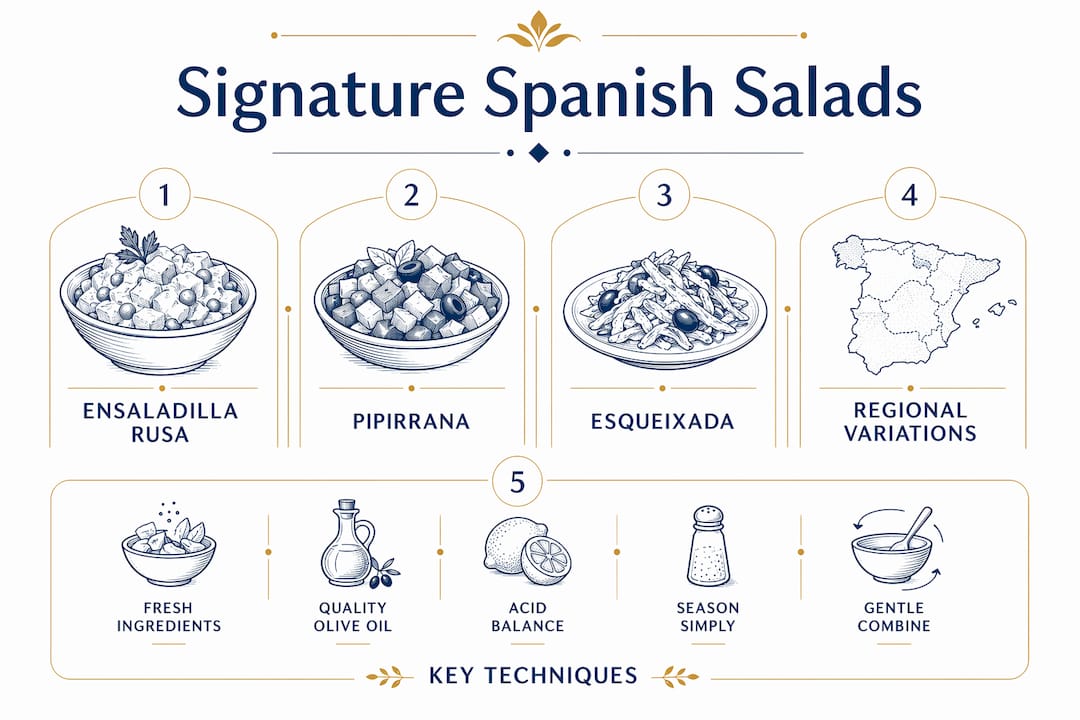
Signature Spanish salads are traditional dishes built on a handful of bold, fresh ingredients dressed simply with extra virgin olive oil, sherry vinegar, and salt. Knowing what are signature Spanish salads means understanding that these are not background sides. Ensaladilla Rusa, Pipirrana, and Esqueixada each represent a distinct regional tradition, a specific protein or vegetable base, and a preparation philosophy that prioritizes texture and natural flavor over complexity. These salads reset the palate between richer dishes rather than fill space on the table.
What are the most popular traditional Spanish salads?
Traditional Spanish salads fall into three main categories: cold tapa salads, raw vegetable salads, and preserved protein salads. Each category uses a short ingredient list to deliver maximum flavor.
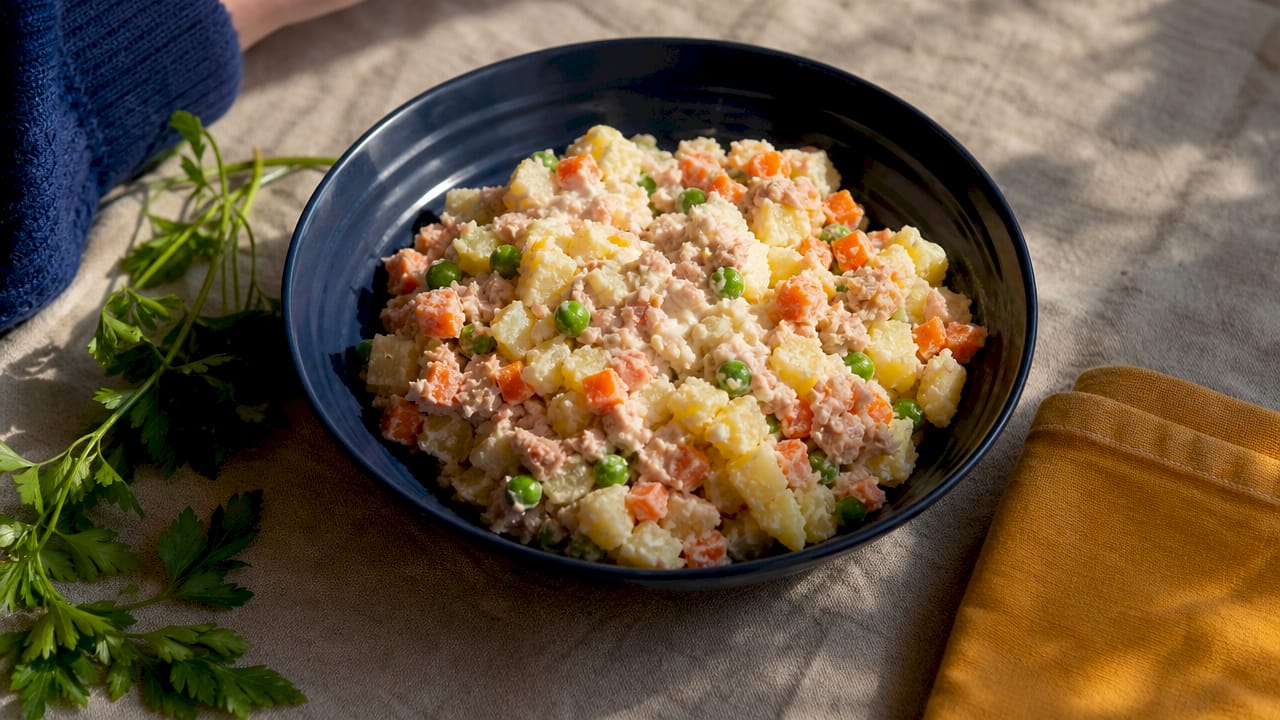
Ensaladilla Rusa is Spain’s most recognized cold tapa salad. It combines boiled potatoes, canned tuna, peas, carrots, and homemade mayonnaise. The Spanish version uses canned tuna rather than the meat found in the original Russian Olivier salad. That substitution makes it lighter, more affordable, and deeply tied to Spanish pantry culture. It serves 4–8 people and takes 30–45 minutes to prepare, including refrigeration time.
Pipirrana is the signature summer salad of Andalusia. It features ripe tomatoes, cucumber, green bell pepper, onion, extra virgin olive oil, and sherry vinegar. Prep takes about 20 minutes, and the dressing forms naturally from the vegetables themselves rather than from a bottled sauce.
Esqueixada is Catalonia’s answer to the summer salad. It uses raw, desalted salt cod shredded by hand, layered with tomatoes, onions, black olives, and roasted peppers. Nothing is cooked. The result is a salad with firm texture and a clean, briny flavor that no leafy green can replicate.
Comparison of core Spanish salads
| Salad | Region | Main protein | Key vegetables | Dressing |
|---|---|---|---|---|
| Ensaladilla Rusa | Nationwide | Canned tuna | Potato, peas, carrot | Homemade mayonnaise |
| Pipirrana | Andalusia | Optional (egg, tuna) | Tomato, cucumber, pepper | Olive oil, sherry vinegar |
| Esqueixada | Catalonia | Desalted salt cod | Tomato, onion, olive | Olive oil, red wine vinegar |
| Ensalada Mixta | Nationwide | Hard-boiled egg | Lettuce, tomato, olive | Olive oil, salt |
| Ensalada Malagueña | Málaga | Salt cod, orange | Potato, onion | Olive oil, vinegar |
The Ensalada Mixta is the everyday workhorse of Spanish dining. It appears on nearly every restaurant menu and combines lettuce, tomato, hard-boiled egg, olives, and canned tuna with a simple olive oil and salt dressing. The Ensalada Malagueña from Málaga adds orange slices and salt cod to boiled potatoes, creating a sweet-savory balance that surprises most first-time visitors.
How do regional differences shape Spanish salad types?
Spain’s geography drives its salad culture more than any cookbook does. Each region produces distinct ingredients, and those ingredients define the local salads.
Andalusia specializes in tomato-based summer salads like Pipirrana because the region grows some of Europe’s best tomatoes. The heat also demands quick, refreshing dishes. Pipirrana fits that need perfectly. It requires no cooking, uses pantry staples, and delivers a cooling effect that balances grilled meats or fried fish.
Catalonia’s Esqueixada reflects the region’s deep connection to salt cod, a preserved fish that has fed coastal communities for centuries. The layered presentation of Esqueixada on flat platters is a Catalan signature. Ingredients are never tossed together. Each component sits in its own layer so the cod stays intact and the colors remain vivid.
Málaga and Murcia both produce salads that mix preserved proteins with fresh citrus or vegetables in ways that feel unlike anything from northern Spain. The Ensalada Malagueña pairs salt cod with orange, a combination that sounds odd but works because the acid in the orange cuts through the salt in the fish.
- Andalusian salads: tomato-forward, quick to prepare, rely on sherry vinegar
- Catalan salads: salt cod-based, layered, served at room temperature
- Murcian and Malagueña salads: citrus or preserved vegetable additions, strong umami base
- Northern Spain: lighter green salads with local cheeses or anchovies
Pro Tip: Sherry vinegar is sharper than wine vinegar but less harsh than balsamic. Use it in any Spanish salad dressing for an authentic flavor that olive oil alone cannot deliver.
Seasonal timing also matters. Pipirrana and Esqueixada are summer dishes, best made in july and august when tomatoes peak. Ensaladilla Rusa works year-round because it relies on pantry staples rather than fresh produce at its prime.
What techniques define authentic Spanish salad preparation?
Technique separates a good Spanish salad from a great one. The methods are simple, but skipping them produces flat, watery, or mushy results.
The most important technique in Andalusian salads is cutting tomatoes directly into the serving bowl. Cutting into the serving vessel captures every drop of tomato juice. That juice, combined with salt and sherry vinegar, forms a natural emulsified dressing without any whisking or blending. The result is an umami-rich liquid that coats every ingredient.
For Ensaladilla Rusa, the two critical steps are dicing and folding. Potatoes should be diced after boiling and cooling, not before. Hot potatoes crumble when cut. Cooled potatoes hold their shape. Mayonnaise goes in last and gets folded gently, not stirred. Stirring breaks down the potato cubes and turns the salad into a paste.
Esqueixada demands patience. Ingredients are layered on flat platters, not tossed in a bowl. The shredded cod goes down first, then the vegetables, then the olives and peppers on top. Tossing would shred the cod further and muddy the presentation.
- Always salt tomatoes before adding vinegar to draw out maximum juice
- Use extra virgin olive oil, not regular olive oil, for dressings
- Chill Ensaladilla Rusa for at least 30 minutes before serving so flavors meld
- Desalt cod for Esqueixada in cold water for 24–48 hours, changing the water every 8 hours
- Never dress a salad more than 10 minutes before serving unless the recipe calls for marinating
Pro Tip: Premium canned tuna and homemade mayonnaise are the two ingredients that separate an authentic Ensaladilla Rusa from a mediocre one. Oil-packed tuna in a glass jar delivers far more flavor than water-packed canned tuna.
How can home cooks make Spanish salads at home?
Home cooks outside Spain can replicate these salads with widely available ingredients. The key is substitution logic, not compromise.
- Source sherry vinegar first. Most grocery stores carry it in the vinegar aisle or the international foods section. If unavailable, a mix of white wine vinegar and a small amount of dry sherry approximates the flavor.
- Buy oil-packed canned tuna. Water-packed tuna works in a pinch, but oil-packed tuna delivers the richness that makes Ensaladilla Rusa satisfying as a tapa rather than a diet dish.
- Make mayonnaise from scratch for Ensaladilla Rusa. Store-bought mayonnaise works, but homemade mayo with good olive oil and a touch of lemon changes the dish entirely.
- Chill before serving. Ensaladilla Rusa needs at least 30 minutes in the refrigerator. Pipirrana benefits from 15 minutes of rest so the dressing develops. Esqueixada is best served at cool room temperature, not straight from the fridge.
- Pair with the right foods. Pipirrana pairs with grilled fish or lamb chops. Ensaladilla Rusa works alongside other tapas like patatas bravas or pan con tomate. Esqueixada pairs well with crusty bread and a glass of white wine.
You can find tuna salad variations that follow this same philosophy of quality ingredients and simple preparation. The principle holds whether you are cooking at home or ordering at a restaurant. Presentation also matters. Serve Pipirrana in a wide, shallow bowl so the dressing pools visibly. Plate Esqueixada on a flat platter to show the layers. Serve Ensaladilla Rusa in a mound with a drizzle of olive oil and a few olives on top.
Key Takeaways
Signature Spanish salads deliver bold flavor through ingredient quality and precise technique, not through complex recipes or long ingredient lists.
| Point | Details |
|---|---|
| Three core salad types | Ensaladilla Rusa, Pipirrana, and Esqueixada define the signature Spanish salad tradition. |
| Regional identity matters | Andalusia, Catalonia, and Málaga each produce salads tied to local ingredients and climate. |
| Technique drives texture | Dice potatoes after cooling, layer Esqueixada, and cut tomatoes into the bowl to preserve quality. |
| Sherry vinegar is non-negotiable | It creates the sharp, balanced dressing that distinguishes Spanish salads from generic Mediterranean ones. |
| Ingredient quality decides flavor | Premium canned tuna and homemade mayonnaise separate authentic Ensaladilla Rusa from average versions. |
Why Spanish salads deserve more respect than they get
Most food writing treats Spanish salads as an afterthought, a few lines before the paella section. That framing misses the point entirely.
These salads are precision instruments. Pipirrana is not a chopped vegetable dish. It is a carefully timed flavor reset that works because the tomato juice, salt, and sherry vinegar interact over exactly the right resting period. Esqueixada is not a fish salad. It is a study in texture contrast: silky desalted cod against firm tomato, briny olives against sweet roasted pepper. Every element earns its place.
What I find most interesting about Spanish salad culture is how it resists the urge to add more. American salad culture defaults to more ingredients, more toppings, more dressing. Spanish salad culture defaults to less. The Ensalada Mixta has five ingredients. Pipirrana has six. That restraint is not laziness. It is confidence in the raw material.
The technique details matter more than most home cooks realize. Cutting tomatoes into the bowl instead of on a cutting board sounds trivial. The flavor difference is not trivial. You can explore Mediterranean salad recipes to see how this philosophy extends beyond Spain. The lesson applies everywhere: respect the ingredient, use the right acid, and stop adding things.
— YellowRock
Authentic Spanish salads at Kokcha in Barcelona
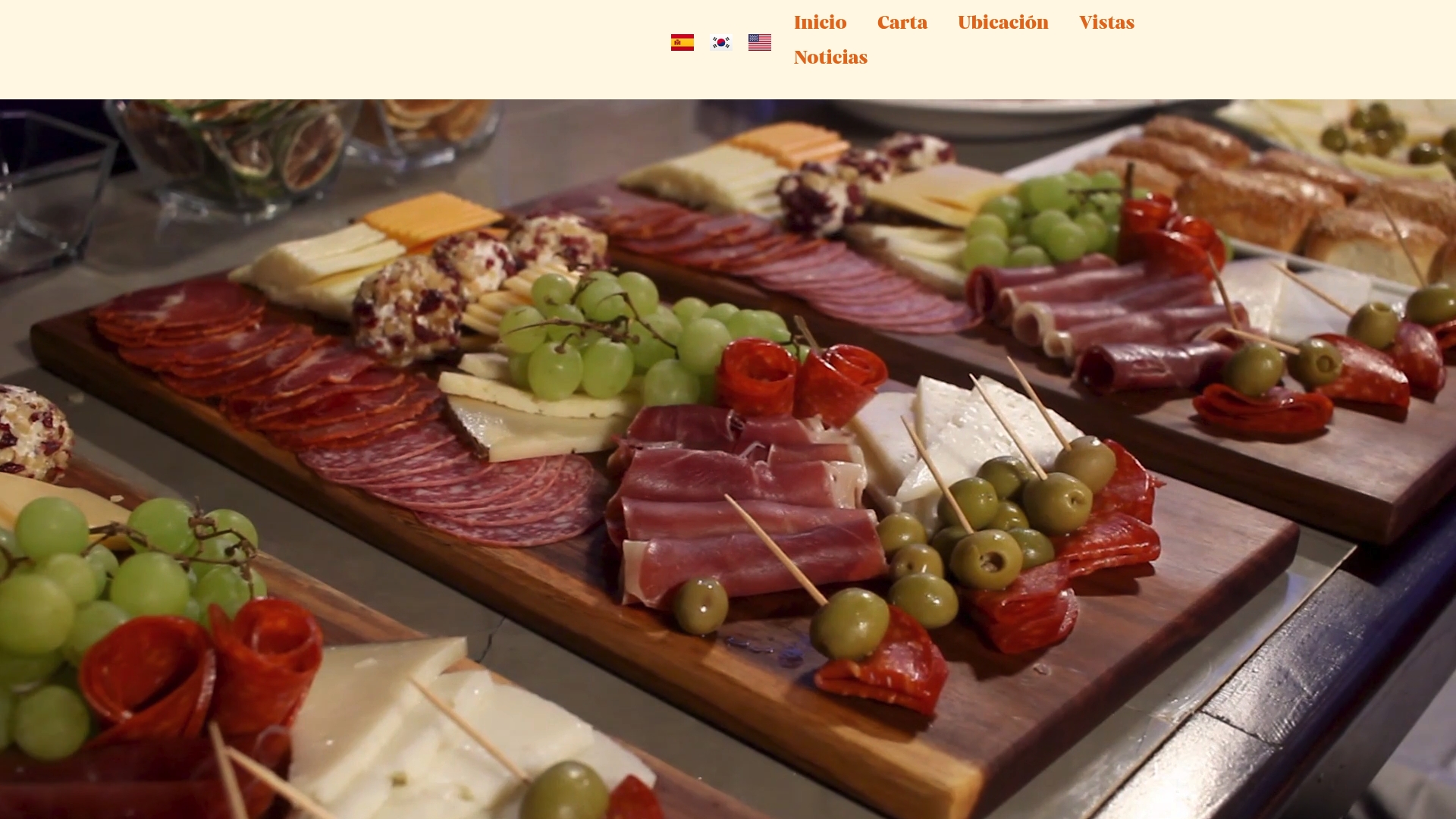
Kokcha is a Mediterranean restaurant in Barcelona, steps from the Sagrada Familia, where traditional Spanish salads appear on the menu alongside tapas, paellas, and fresh seafood. The kitchen applies the same ingredient-first philosophy described in this article. Premium olive oil, quality proteins, and seasonal vegetables go into every dish. If you want to taste what authentic Mediterranean dining looks like in 2026, Kokcha’s menu reflects the current direction of Spanish and Mediterranean gastronomy. The terrace offers views of the Sagrada Familia, making it one of the more memorable settings in the city for a long, relaxed meal built around great food.
FAQ
What are the main types of signature Spanish salads?
The three main types are Ensaladilla Rusa, Pipirrana, and Esqueixada. Each represents a different region and uses a distinct protein base: canned tuna, fresh vegetables, or desalted salt cod.
What ingredients are in a traditional Pipirrana?
Pipirrana contains ripe tomatoes, cucumber, green bell pepper, onion, extra virgin olive oil, and sherry vinegar. Some versions add hard-boiled egg or canned tuna.
How is Esqueixada different from other Spanish salads?
Esqueixada uses raw, desalted salt cod as its base and is never cooked or tossed. Ingredients are layered on a flat platter to preserve texture and visual presentation.
What makes Ensaladilla Rusa authentically Spanish?
The Spanish version replaces the meat in the original Russian Olivier salad with canned tuna and uses homemade mayonnaise. Ingredient quality, especially the tuna and mayo, defines the authentic version.
Can I make Spanish salads without sherry vinegar?
Sherry vinegar is the preferred acid in most Spanish salads. A mix of white wine vinegar and a small amount of dry sherry is the closest substitute when sherry vinegar is not available.