Location is the single most consequential decision a restaurant owner makes. Before the first plate leaves the kitchen, before a single marketing dollar is spent, the address determines who walks through the door, how often, and whether the numbers ever work. Research confirms a 0.81 correlation between location parameters and restaurant success. That figure alone should reframe how seriously you treat site selection.
Table of Contents
- Why location is vital for a restaurant’s success
- Key factors to consider when selecting a restaurant location
- How location shapes brand perception and marketing effectiveness
- Data-driven approaches to restaurant site selection in Central Europe
- Key Takeaways
Why location is vital for a restaurant’s success
The importance of location for restaurants goes well beyond real estate. It defines your customer base, your revenue ceiling, and your operating costs simultaneously. Get it right and the location does half your marketing for you. Get it wrong and no amount of great food or social media spend closes the gap.
- Customer access and demographic fit: A location only works if the surrounding population matches your concept and price point. High foot traffic from the wrong demographic is just noise.
- Visibility drives spontaneous visits: Restaurants on corner units, near landmark entrances, or on high-pedestrian streets capture walk-in business that interior or back-street spots simply never see.
- Competitive and complementary proximity: Being near similar restaurants often helps rather than hurts. Dining clusters create destination areas where customers expect to choose between options.
- Economic and demographic profile: Living standards, education levels, and income in the surrounding area correlate strongly with restaurant success. A location where residents dine out regularly is structurally different from one where they rarely do.
- Lease costs and regulations: A site that looks profitable on paper can become unsustainable when rent exceeds healthy thresholds or local zoning creates operational constraints.
Key factors to consider when selecting a restaurant location
Site selection is an economics problem, not an aesthetics one. Operators must ensure the local population’s income, age, and lifestyle preferences align with their concept before anything else. A beautiful space in the wrong neighborhood is a liability.
Foot traffic timing matters more than totals. Daypart-specific foot traffic is what actually drives revenue. A lunch-focused fast-casual concept needs dense midday pedestrian flow, not just strong evening numbers. Hybrid work patterns across Central European cities have shifted weekday office-area traffic significantly, so evaluating occupancy patterns near office districts is now a prerequisite for lunch-centric formats.
Demographic and income matching is where most first-time operators make their mistake. They fall for a busy street without checking whether the people walking it can afford the menu or want the cuisine. Spend time on-site at different hours before committing.

Accessibility and parking directly affect whether customers return. Research shows accessibility, parking, and visibility are the top three location factors influencing both customer satisfaction and profit. A recommended starting point is to have enough parking spaces to adequately serve your seating capacity; when parking is tight, budget for valet as an operational cost, not an afterthought.
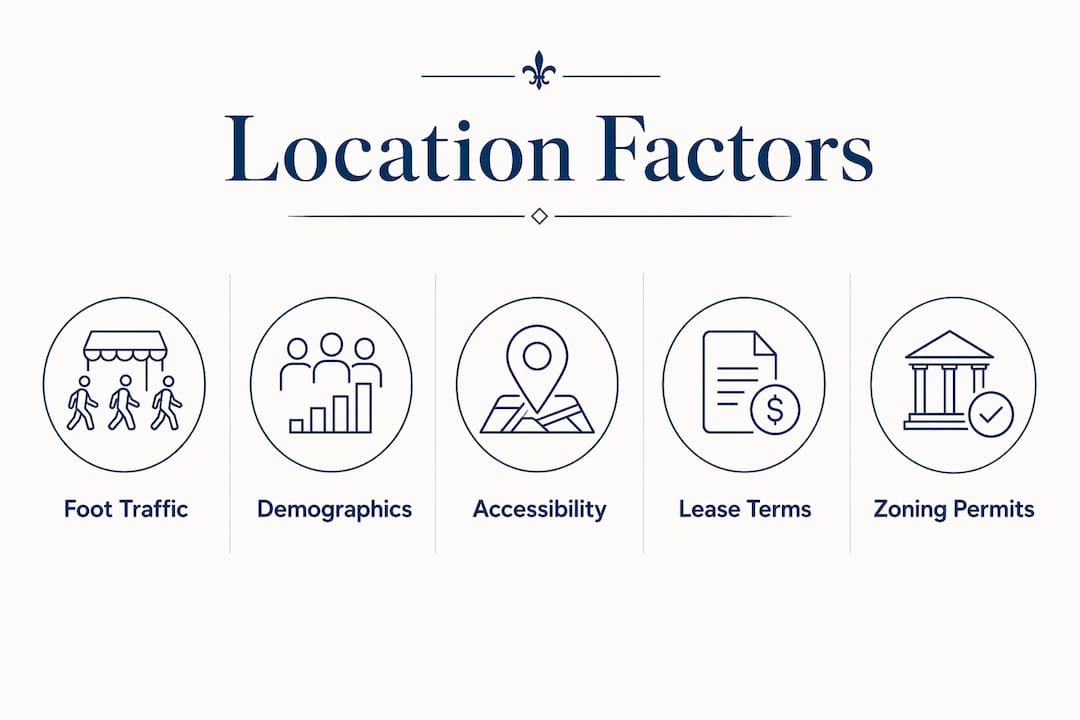
Lease terms and rent-to-revenue ratios are the financial backbone of site feasibility. Healthy rent should be kept at a sustainable proportion of annual revenue, as excessive rent creates a structural disadvantage that marketing cannot fix. Negotiate fixed annual increases and secure renewal options before signing anything.
Zoning and permits vary significantly across Central European municipalities. What is allowed in one district may require a special variance in the next. Confirm food service permits, outdoor seating rights, and noise regulations before you fall in love with a space.

Pro Tip: Build a weighted scoring matrix before visiting any site. Assign weights to foot traffic timing, demographic fit, rent-to-revenue ratio, accessibility, and zoning. Score each candidate location against the same criteria. The matrix removes emotion from the decision and makes side-by-side comparisons honest.
How location shapes brand perception and marketing effectiveness
Where you open tells customers what kind of restaurant you are before they read a single review. A spot near a major cultural landmark signals accessibility and confidence. A tucked-away address in a residential block signals intimacy and neighborhood loyalty. Neither is wrong, but both are deliberate choices with real marketing consequences.
Physical visibility reduces acquisition costs. A high-visibility location acts as its own advertising. Frontage on a busy street, clear signage, and an attractive exterior generate awareness passively. The impact of location on dining experience begins before the customer steps inside: visibility from the main road is one of the strongest predictors of walk-in traffic.
Digital findability amplifies physical presence. A well-chosen address in a recognized neighborhood ranks more naturally on Google Maps and platforms like TripAdvisor. Proximity to landmarks boosts discoverability because tourists and visitors search by area. Pairing strong restaurant SEO with a high-visibility physical location compounds both effects.
Neighborhood character shapes perceived brand positioning. A restaurant in a culturally rich, high-footfall area inherits some of that area’s cachet. Kokcha’s position near the Sagrada Familia in Barcelona is a clear example: proximity to landmarks can significantly increase restaurant success, and the surrounding neighborhood communicates quality and destination dining before a guest arrives.
Safety and comfort affect repeat visits. Customers who feel comfortable walking to and from a restaurant at night return more often. Neighborhood safety is not a soft factor; it directly influences frequency of visit and word-of-mouth referrals. The role of location in restaurant choice consistently includes environmental comfort as a key driver of satisfaction.
Data-driven approaches to restaurant site selection in Central Europe
Leading chains no longer rely on gut feel for site selection. AmRest uses location intelligence platforms to analyze foot traffic, consumer demographics, and competitive density when expanding in Germany. GeoAI and spatial benchmarking allow operators to validate on-site intuition with structured data, reducing the risk of committing to a long-term lease on a flawed assumption.
The core of any data-driven approach is layering multiple data types simultaneously: daypart foot traffic, commuter flow direction, demographic income bands, and competitor density within a defined radius. Foot traffic is directional and time-sensitive; commuters moving homeward in the evening behave differently from lunchtime pedestrians, and a dinner-focused concept needs to account for which direction traffic flows past the front door.
| Data Layer | What It Tells You | Why It Matters |
|---|---|---|
| Daypart foot traffic | Volume by hour and day | Matches traffic timing to your peak service hours |
| Demographic overlay | Income, age, lifestyle | Confirms concept and price point alignment |
| Competitor density | Number and type of nearby restaurants | Identifies clusters vs. oversaturated zones |
| Commuter flow direction | Morning vs. evening movement patterns | Predicts dinner vs. lunch capture potential |
| Rent-to-revenue modeling | Projected rent as % of forecast sales | Flags financially unsustainable sites early |
Financial modeling is where data-driven selection pays off most clearly. Running rent-to-revenue projections against realistic sales forecasts, rather than optimistic ones, surfaces sites that look attractive but are structurally unprofitable. A rent threshold exists as a hard guardrail to maintain financial viability, not just a guideline.
Pro Tip: When negotiating a lease in Central Europe, push for fixed annual rent increases of 2%–3% and structure the agreement with a 5-year initial term plus two 5-year renewal options. This protects your investment in kitchen infrastructure and gives you time to build a loyal customer base before facing any rent renegotiation.
Combining on-site evaluation with spatial data models is the standard practice among serious operators. The data narrows the field; the site visit confirms what the data cannot measure, like natural light, noise levels, and the actual feel of the space at different times of day.
Key Takeaways
Location is the foundational decision in restaurant success, determining demographic fit, revenue potential, and financial sustainability before a single customer arrives.
| Point | Details |
|---|---|
| Demographic match is non-negotiable | The local population’s income and lifestyle must align with your concept and price point. |
| Rent-to-revenue ratio is a hard guardrail | Keep rent between 6% and 10% of projected annual revenue to stay financially viable. |
| Daypart traffic beats aggregate totals | Analyze foot traffic by time of day to confirm it matches your peak service hours. |
| Proximity to landmarks boosts success | Research shows proximity to city landmarks can significantly increase restaurant success. |
| Data models reduce irreversible risk | GeoAI and spatial benchmarking, as used by AmRest, validate site decisions before lease signing. |
Kokcha’s location steps away from the Sagrada Familia is a real-world example of restaurant location strategy executed with intention: landmark proximity, high international foot traffic, and a neighborhood that signals quality dining. If you want to see how location, ambiance, and Mediterranean cuisine come together, explore what Kokcha offers at one of Barcelona’s most strategically positioned tables.