Mediterranean flavors are defined by a balance of fresh herbs, bright citrus, quality olive oil, and minimally processed plant-based foods that create vibrant, layered tastes without heavy sauces or dominant heat. This flavor tradition spans more than a dozen countries bordering the Mediterranean Sea, yet it holds together through shared principles: fat from olives, acidity from lemon, and aromatics from garlic and herbs. If you have ever tasted a Greek salad dressed with oregano and extra virgin olive oil, or a Moroccan tagine fragrant with cumin and coriander, you have already experienced what Mediterranean cooking does best. This guide breaks down the core components, regional differences, and practical techniques so you can build these flavors confidently at home.
What are the key ingredients in Mediterranean flavor profiles?
The Mediterranean flavor profile is built on a short list of high-quality ingredients rather than a complex spice cabinet. Harvard Health identifies olive oil as the principal fat, paired with fresh herbs and lemon juice as the signature flavor combination. That trio alone explains why Mediterranean food tastes simultaneously rich and light.
The core ingredients fall into a few clear categories:
- Olive oil: Extra virgin olive oil (EVOO) is both a cooking fat and a finishing condiment. It carries fat-soluble flavor compounds from herbs and garlic, making it the single most important ingredient in the pantry.
- Fresh herbs: Oregano, parsley, basil, and mint appear across the region. Dried oregano is used more liberally in Greek and Italian cooking; fresh parsley and mint dominate Levantine dishes like tabbouleh.
- Citrus: Lemon juice and zest provide the acidity that lifts every dish. Without it, olive oil-based cooking can taste flat and heavy.
- Aromatics: Garlic and onion create the base layer of depth in sauces, marinades, and roasted vegetables.
- Briny and fermented elements: Core staples include capers, anchovies, olives, and feta cheese. These ingredients add salty, umami depth that replaces the role heavy spices play in other cuisines.
- Legumes and vegetables: Chickpeas, lentils, eggplant, tomatoes, and zucchini provide texture and a subtle earthiness that rounds out the flavor.
Pro Tip: Add a squeeze of lemon and a drizzle of raw EVOO to any finished dish before serving. This two-second step is the single fastest way to make a plate taste authentically Mediterranean.
The characteristics of Mediterranean cuisine are not about complexity. They are about using fewer, better ingredients and letting each one contribute its distinct note to a balanced whole.
How do Mediterranean flavor profiles vary by region?
Mediterranean flavor is not one uniform taste. It is a family of related regional profiles that share core ingredients but diverge sharply in spice use, technique, and cultural influence. Understanding these differences is what separates a curious home cook from one who can actually replicate a specific dish.
The table below shows how the three main Mediterranean zones differ in their flavor emphasis:
| Region | Dominant herbs and spices | Signature flavor notes | Example dishes |
|---|---|---|---|
| Southern Europe (Greece, Italy, Spain) | Oregano, basil, rosemary, saffron | Herbaceous, briny, slightly acidic | Greek salad, pasta al pomodoro, paella |
| Levant (Lebanon, Syria, Palestine, Israel) | Za’atar, sumac, allspice, cumin | Tangy, earthy, floral | Fattoush, hummus, kibbeh |
| North Africa (Morocco, Tunisia, Algeria) | Cumin, coriander, cinnamon, harissa | Warm, aromatic, mildly spiced | Tagine, shakshuka, couscous |
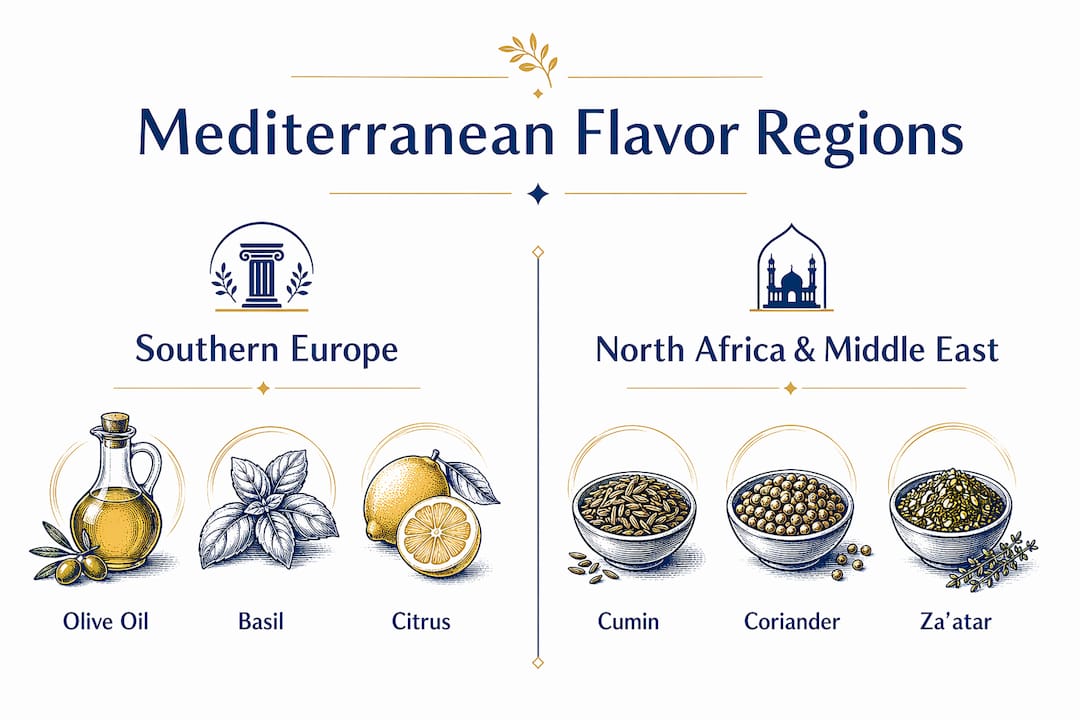
North African cuisine uses cumin, coriander, and cinnamon in ways that feel closer to Middle Eastern cooking than to Italian. Greek cooking favors oregano and cinnamon together, particularly in meat dishes. Spanish cuisine incorporates smoked paprika, saffron, and nuts in ways that reflect both Moorish and European influences.
Za’atar illustrates how specific a regional flavor identity can get. This thyme-based spice blend is pivotal in Palestinian cuisine and carries deep cultural meaning beyond its taste. It is a reminder that Mediterranean flavors are not interchangeable. Each region’s profile reflects its history, trade routes, and agricultural landscape.
For home cooks, this regional context matters practically. If you want to cook Levantine food, stock sumac and allspice. If you are cooking Spanish, reach for smoked paprika and saffron. The shared foundation of olive oil and fresh vegetables holds, but the spice drawer changes completely. You can explore how regional Mediterranean dishes express these differences through their iconic preparations.
What cooking techniques enhance Mediterranean flavors?
Technique is where Mediterranean cooking separates itself from simply assembling good ingredients. Mediterranean flavors emphasize technique and ingredient balance over any single spice blend, which means how you cook matters as much as what you cook.
Follow these core methods to build authentic flavor:
- Use EVOO in two stages. Cook aromatics like garlic and onion in olive oil at medium heat to build a flavor base. Then finish the dish with a separate drizzle of raw EVOO. Applying EVOO both during cooking and as a finishing element preserves its complexity and provides brightness that cooked oil alone cannot deliver.
- Layer acidity at the end. Add lemon juice or a splash of red wine vinegar in the final 30 seconds of cooking or directly on the plate. Heat destroys the volatile compounds that make citrus taste fresh, so timing matters.
- Roast vegetables until caramelized. Roasting eggplant, tomatoes, peppers, and zucchini at high heat (around 425°F) develops sweetness and depth through caramelization. This technique is the backbone of dishes like baba ganoush and ratatouille.
- Add fresh herbs at the right moment. Woody herbs like rosemary and thyme can go in early during cooking. Delicate herbs like parsley, mint, and basil should be added raw at the end to preserve their aroma.
- Balance fat and acid deliberately. Fat carries flavor while acid sharpens it. A dish that tastes flat usually needs more acid. A dish that tastes sharp usually needs more fat. Adjusting these two elements is the core skill of Mediterranean cooking.
Pro Tip: When a Mediterranean dish tastes “almost right” but something is missing, add lemon zest rather than more juice. Zest delivers citrus aroma without extra acidity, which is often the missing layer.
How to build a Mediterranean pantry for authentic flavor at home
A well-stocked Mediterranean pantry does not require exotic or expensive ingredients. A starter pantry built around olive oil, lemon, garlic, oregano, parsley, mint, and basil covers the majority of recipes from Greece, Italy, Spain, and the Levant.
Here is what to prioritize:
- Extra virgin olive oil: Buy a cold-pressed EVOO with a harvest date on the label. Freshness matters. Oil older than 18 months loses the peppery, grassy notes that define the flavor.
- Lemons: Keep fresh lemons on hand at all times. Bottled lemon juice lacks the volatile oils in fresh zest and produces a flat, slightly bitter result.
- Dried oregano and dried thyme: These hold their flavor well and are the workhorses of Mediterranean herb combinations in marinades and roasted dishes.
- Fresh parsley and mint: Grow these on a windowsill or buy weekly. They are used in such large quantities in Levantine cooking that dried versions are not an adequate substitute.
- Canned chickpeas and lentils: These provide protein and earthy flavor in minutes without soaking.
- Capers and good-quality olives: Both add briny depth that replaces the need for heavy seasoning.
- Feta cheese: Crumbled feta adds salt, fat, and tang simultaneously, functioning as both a seasoning and a topping.
Store fresh herbs wrapped in a damp paper towel inside a sealed bag in the refrigerator. They last up to a week this way instead of two or three days loose in the crisper. For dried herbs, replace them every six months. Flavor compounds degrade faster than most cooks realize, and old oregano is one of the most common reasons a Mediterranean dish tastes dull.
How do Mediterranean flavors compare with other regional cuisines?
Mediterranean cooking occupies a distinct position among the world’s major flavor traditions. Mediterranean flavors avoid reliance on heavy chili heat or sugar sweetness, instead layering salt, herbs, olive oil, and lemon to create nuanced, balanced seasoning. That restraint is what makes the cuisine feel simultaneously light and satisfying.
The contrast with other major culinary traditions is clear:
| Cuisine | Primary flavor drivers | Fat source | Heat level | Sweetness |
|---|---|---|---|---|
| Mediterranean | Herbs, citrus, olive oil | Olive oil | Low | Minimal |
| Northern European | Butter, cream, root vegetables | Butter, cream | Very low | Moderate |
| South Asian | Chili, cumin, turmeric, garam masala | Ghee, vegetable oil | High | Low to moderate |
| East Asian | Soy, ginger, sesame, fermented pastes | Sesame oil, neutral oil | Low to moderate | Moderate |
Northern European cooking relies on butter and cream for richness, which produces heavier, more coating flavors. South Asian cooking builds complexity through layered dry spices and chili heat. East Asian cooking uses fermented and umami-forward condiments as its flavor backbone. Mediterranean cooking, by contrast, tastes lighter but not bland because acidity and fresh herbs lift the richness of olive oil-based dishes. The result is food that feels bright and clean on the palate even when it is technically quite calorie-dense.
For home cooks who want to understand unique Mediterranean flavor differences in practice, the simplest test is this: dress the same roasted vegetables with butter and thyme, then again with olive oil, lemon, and oregano. The difference in brightness and freshness is immediate and unmistakable.
Key takeaways
Authentic Mediterranean flavor requires the balanced trio of olive oil, fresh acid, and herbs. Remove any one element and the dish loses its defining character.
| Point | Details |
|---|---|
| Olive oil is the foundation | Use cold-pressed EVOO both as a cooking fat and a raw finishing drizzle for full flavor. |
| Acid is non-negotiable | Add lemon juice or vinegar at the end of cooking to lift richness and prevent flat flavors. |
| Regional profiles differ significantly | North African, Levantine, and Southern European cuisines share ingredients but use distinct spice combinations. |
| Fresh herbs have timing rules | Add woody herbs early in cooking; add delicate herbs like parsley and mint raw at the finish. |
| Mediterranean flavors are not spicy or sweet | The cuisine relies on herbal aromatics and acidity rather than chili heat or sugar-forward seasoning. |
What I have learned cooking Mediterranean food at home
The biggest mistake home cooks make with Mediterranean food is over-seasoning early and under-finishing at the end. Most of the flavor in a great Mediterranean dish comes from what you add in the last 60 seconds: raw olive oil, fresh herbs, a squeeze of lemon, a pinch of flaky salt. Cooks who add everything at the start and walk away produce food that tastes cooked-down and flat, even with excellent ingredients.
The second mistake is treating olive oil as interchangeable with any other cooking fat. A grassy, peppery EVOO from Spain or Greece carries flavor compounds that neutral oils simply do not have. When you use it raw as a finish, those compounds hit your palate directly. That is the moment a dish goes from “good” to “tastes like a restaurant in Barcelona.”
My honest advice: buy one bottle of genuinely good EVOO, keep fresh lemons in the house, and grow or buy fresh parsley. With those three things, you can make food that tastes authentically Mediterranean before you have mastered a single recipe. The technique follows naturally once you understand what you are building toward.
— YellowRock
Taste authentic Mediterranean flavors at Kokcha in Barcelona

Kokcha is a Mediterranean restaurant in Barcelona located steps from the Sagrada Família, and it brings together the full range of flavors this article describes: herb-forward tapas, saffron-rich paellas, fresh seafood, and dishes that demonstrate exactly how olive oil, citrus, and quality ingredients work together on a plate. If you want to taste what innovative Mediterranean gastronomy looks like in 2026, Kokcha’s menu is a direct answer. For visitors and Barcelona residents alike, the restaurant offers both an indoor space and a terrace with views that match the quality of the food. Reserve a table and taste the difference that technique and ingredient quality make in person. Explore Mediterranean dining in Barcelona and see what the cuisine looks like at its best.
FAQ
What are the main flavors in Mediterranean cooking?
Mediterranean cooking is defined by herbaceous, bright, and savory flavors built from olive oil, lemon, garlic, and fresh herbs like oregano, parsley, and mint. The profile is light and fresh rather than spicy or cream-heavy.
What traditional Mediterranean spices are used most often?
Oregano, cumin, coriander, cinnamon, and sumac are the most widely used traditional Mediterranean spices, though their frequency varies by region. Southern European cooking favors oregano and rosemary, while North African and Levantine cuisines rely more on cumin, coriander, and sumac.
How do Mediterranean herb combinations differ from other cuisines?
Mediterranean herb combinations prioritize fresh or lightly dried herbs used in large quantities as primary flavoring agents, not as background notes. Parsley, mint, basil, and oregano function as main ingredients rather than garnishes, which is distinct from cuisines where herbs play a secondary role to spice blends.
Can you recreate Mediterranean flavors without specialty ingredients?
Yes. The core Mediterranean flavor profile requires only extra virgin olive oil, fresh lemon, garlic, and dried oregano, all widely available in standard grocery stores. These four ingredients alone produce a recognizable and authentic result.
What makes Mediterranean flavors different from Middle Eastern flavors?
Mediterranean and Middle Eastern cuisines overlap significantly in the Levant region, but Mediterranean cooking generally uses less warm spice (cinnamon, allspice) and more fresh herb volume. Middle Eastern cooking often incorporates richer spice blends and more pronounced sweetness from dried fruits and nuts in savory dishes.