Tapas are one of the most misunderstood concepts in food culture. Ask someone what is the meaning of tapas and you will likely get an answer about small dishes, maybe something with olives or jamón. That answer is technically correct, but it barely scratches the surface. The word “tapa” carries centuries of social history, a contested etymology, and a philosophy of eating that shapes daily life across Spain. This article unpacks all of it, from the literal Spanish definition to the communal rituals that make tapas far more than just a way to snack before dinner.
Table of Contents
- Key Takeaways
- What is the meaning of tapas: etymology and origin
- What tapas actually are
- Tapas culture and the Spanish art of socializing
- Debunking myths about where tapas came from
- How to enjoy tapas the right way
- My take: tapas are a mirror, not just a meal
- Experience authentic tapas at Kokcha in Barcelona
- FAQ
Key Takeaways
| Point | Details |
|---|---|
| Literal meaning of tapa | The word means “lid” or “cover” in Spanish, rooted in the verb tapar, meaning to cover. |
| Tapas are drink companions | Small dishes are traditionally served alongside wine, beer, or vermouth, never as a standalone meal. |
| Culture beats cuisine | The practice of tapeo, moving between bars and sharing plates, defines tapas as a social lifestyle. |
| Regional variation is real | Free tapas exist in some Spanish cities while others charge for every plate ordered. |
| Myths don’t hold up | Popular folklore about royal origins lacks documentary proof, but still shapes Spanish cultural identity. |
What is the meaning of tapas: etymology and origin
The word tapa literally means “lid” or “cover” in Spanish. It comes directly from the verb tapar, which means “to cover.” That connection between the word and the food tradition is where things get interesting, and where the story gets murky.
The most commonly told origin story goes something like this: bartenders in Andalusia would place a small piece of bread or cured meat over a glass of wine to keep out flies and dust. The food became the cover. The cover became a snack. The snack became a tradition. It is a tidy narrative, and it maps neatly onto the literal Spanish root of the word.
Here is the problem: this story is everywhere, but the historical documentation is thin. What we do know is that the word tapa did not enter Spain’s official royal dictionary until the 1930s. Before that, small bites served with drinks in Andalusia were called platillo or cositas, meaning “little plate” or “little things.” The food practice predates the standardized term by generations.
What the etymology does confirm is the conceptual relationship: something that covers a drink, that accompanies it, that sits alongside rather than replaces it. The tapa was never meant to be the main event.
- The verb tapar means to cover, block, or protect
- A tapa as a physical lid is still standard Spanish usage today
- The food meaning evolved from a practical act to a cultural institution
- Regional names like platillo were common long before the term tapa took hold nationally
Pro Tip: When you order at a Spanish bar and want to sound like you know what you’re doing, use the verb tapear or the phrase “ir de tapas” rather than just asking for “tapas.” It signals you understand the practice, not just the product.
What tapas actually are
Tapas can range from a single olive dropped in a saucer to an elaborate plate of braised oxtail. That range is not accidental. It reflects the entire philosophy of the tradition: small, varied, meant to be shared or sampled alongside a drink.
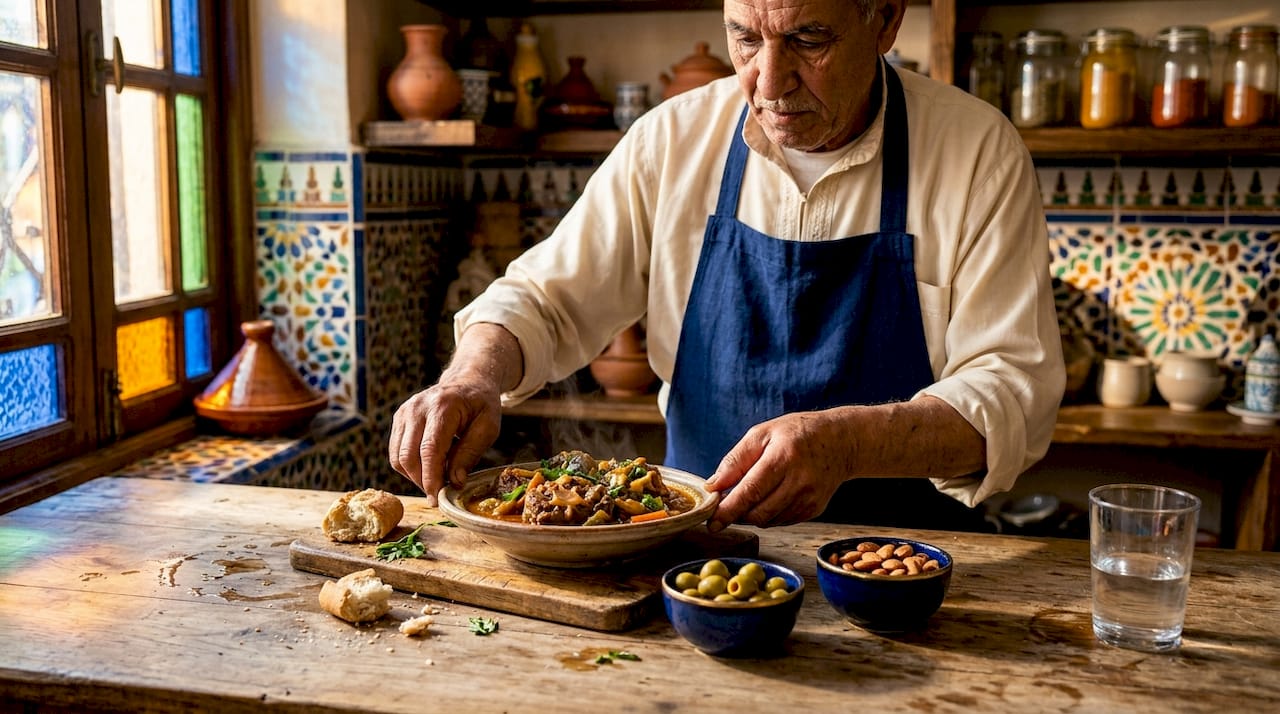
The drinks matter as much as the food. Common pairings include wine, cold beer, and vermouth, with each pairing shifting what makes sense on the plate. A glass of dry sherry calls for something briny like anchovies or Manchego. A cold caña (small draft beer) works beautifully with patatas bravas or calamares.
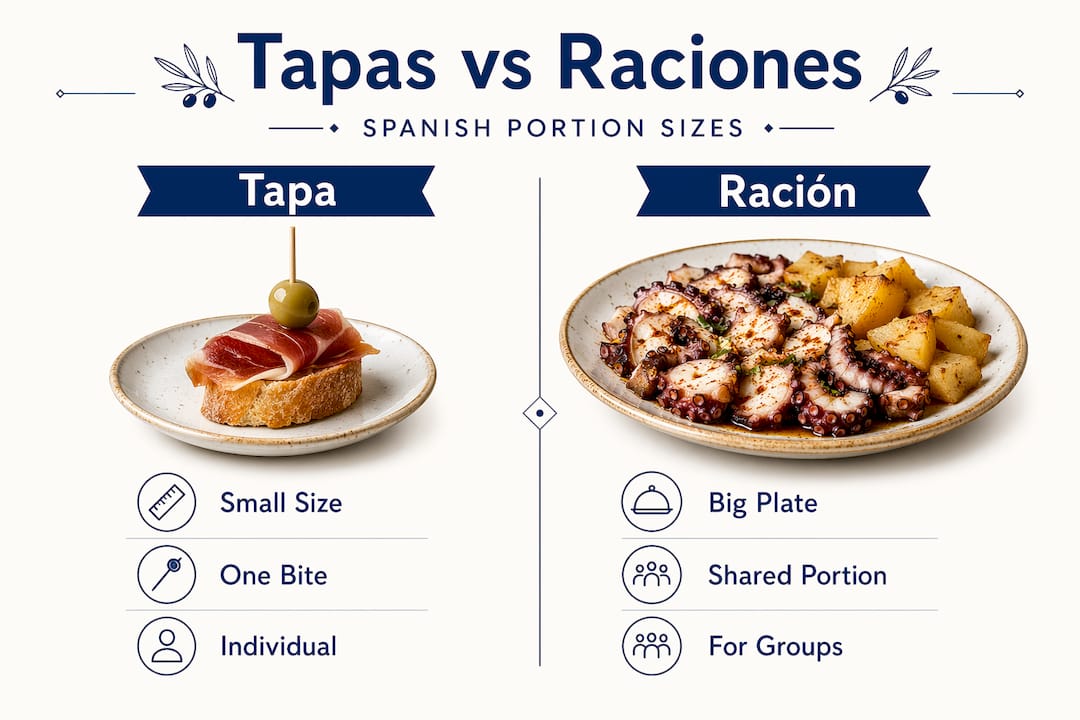
Understanding portion terminology helps you navigate any Spanish bar menu with confidence.
| Term | Size | Description |
|---|---|---|
| Tapa | Small | A bite-sized portion, sometimes free with a drink |
| Pincho | Small | A snack served on bread or a skewer |
| Ración | Medium to large | A full shared plate, enough for two to three people |
| Media ración | Medium | Half a ración, good for solo dining or sampling |
| Montadito | Small | A small open-faced sandwich, common in northern Spain |
The distinction between a tapa, ración, and pincho is not just semantic. Ordering the wrong portion in the wrong context can completely change the experience. A ración at a crowded bar at noon signals you are settling in for a while. A tapa signals you are passing through, tasting, moving on.
Regional variation runs deep. In Granada and Almería, ordering a drink still gets you a free tapa brought automatically by the bartender. In Barcelona and Madrid, you pay for every plate. Neither approach is more authentic. They simply reflect different local economies and traditions.
Pro Tip: In cities where tapas are complimentary, do not ask to choose what comes out. The bartender decides. Accepting this gracefully is part of the experience.
Tapas culture and the Spanish art of socializing
Tapas are always an accompaniment to drinks, and tapeo involves moving from bar to bar to sample each place’s specialties. That movement is the whole point. You are not sitting down for a meal. You are in motion, standing at the bar, talking with whoever is next to you, then drifting somewhere else.
The Spanish phrase ir de tapas literally means “to go for tapas,” but its real translation is closer to “to spend an afternoon or evening being human with other people.” Chef José Andrés describes tapas as a “commitment to being together” and a Spanish way of sharing life. That framing is not poetic license. It is functionally accurate.
Here is what the practice actually looks like from the inside:
- Groups meet at a first bar around midday or early evening, order drinks, receive or choose a tapa
- Conversation flows until the group feels ready to move, often without any formal announcement
- The next bar has different specialties, different regulars, a different mood
- No one eats a full plate alone; everything goes to the center of the table or the counter
- The evening ends not at a fixed time but when it naturally concludes
The Spanish proverb “eat when you drink and drink when you eat” captures this philosophy precisely. Spain has even sought UNESCO recognition for tapas as an intangible cultural heritage, which tells you something about how seriously the country takes this tradition.
What distinguishes tapas culture from other forms of casual dining is the deliberate absence of efficiency. There is no agenda, no set menu, no defined endpoint. That is a feature, not a flaw.
Debunking myths about where tapas came from
The most famous tapas origin story involves King Alfonso XIII stopping at a Cádiz inn, where a bartender placed a slice of ham over his wine glass to protect it from dust. The king supposedly enjoyed the snack and ordered another. The practice spread from there.
It is a great story. It is almost certainly not true. Here is why historians push back:
- No documentary evidence exists to support the royal origin claim. Not a contemporary account, not a court record, not a regional chronicle.
- The practice of placing bread or food over drinks was already widespread in Andalusia before any specific royal anecdote was attached to it.
- The word tapa only officially entered the language in the 1930s, long after the supposed royal endorsement.
- Multiple Spanish regions have competing origin stories, each claiming local credit for the tradition.
- These stories tend to emerge and solidify in the 20th century, often in tourist-facing contexts, suggesting they serve a cultural branding purpose.
None of this means the stories are harmful. Folklore about food serves a real function. It gives a tradition an identity, a face, a sense of inherited meaning. The royal ham story communicates something true about Spanish culture even if the event never happened: that hospitality and resourcefulness are values the culture honors. Understanding this gap between myth and documented history makes you a more informed traveler and a sharper reader of cultural narratives.
How to enjoy tapas the right way
If you want to experience ordering tapas like a local, start by letting go of the table-centric, multi-course dinner mentality. Tapas do not work that way. The bar counter is where the action is, and standing at it signals participation.
A few practical principles that will change the quality of your experience:
- Arrive between 1:00 and 3:00 pm or between 8:00 and 10:00 pm. These are the actual eating hours in Spain. Showing up at 6:00 pm will get you an empty bar and confused looks.
- Do not try to order everything at once. Pick one or two tapas, finish your drink, then decide whether to order more or move on.
- When a menu lists a dish as para compartir (to share), take that literally. Order it for the table.
- Pair your drinks intentionally: vermouth with anchovies or olives, beer with fried dishes, wine with cured meats or cheese.
- At festivals and tapas events in cities like Reus, you can often get a combined ticket covering three tapas and two drinks for around 12 euros, making them an affordable way to sample local specialties.
Understanding tapas as unforgettable dining experiences requires you to stop measuring success by how full you feel at the end. The measure is how present you were during the conversation.
My take: tapas are a mirror, not just a meal
I have sat at more tapas bars than I can count, from the standing-room-only counters in Seville to the polished marble bars of San Sebastián. And the thing that consistently surprises people who encounter tapas culture for the first time is how little it is about the food.
Do not misread that. The food matters. A perfect croqueta de jamón, crisp on the outside and molten in the center, is genuinely transcendent. But the food is the excuse, not the point. What tapas actually do is create the conditions for human connection with almost no effort. You stand next to a stranger. Someone pushes a plate toward you. You take a bite. A conversation starts.
Chef José Andrés calls tapas a “cultural Trojan horse” that introduced shared plates to the world. I think that framing is exactly right. Every culture has food rituals. What makes tapas distinct is the architecture of spontaneity built into the practice. There is no reservation, no fixed menu, no bill you have to split awkwardly. The whole system is designed to make connection easy and exit graceful.
What I find most worth thinking about is how much this contrasts with efficiency-first dining cultures where meals are transactions and speed is a virtue. Tapas are deliberately slow. They resist optimization. And that resistance is the point.
— Kokcha
Experience authentic tapas at Kokcha in Barcelona
If this article has made you want to sit at a counter with a cold caña and a plate of something good, Kokcha is exactly where to do it. Located steps from the Sagrada Família, Kokcha serves Mediterranean and Spanish tapas-style dishes in a setting that feels genuinely local rather than tourist-facing.
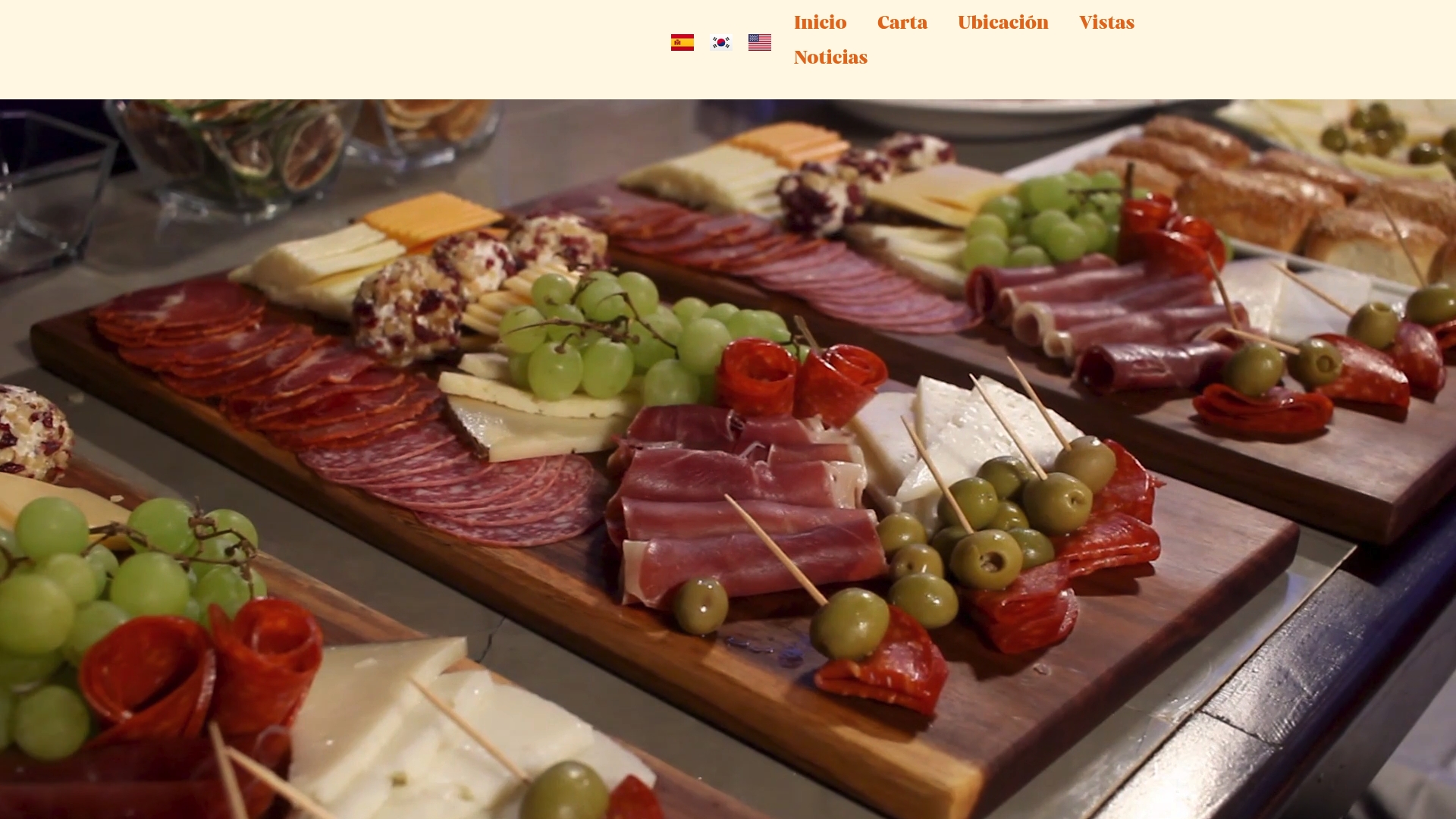
The kitchen draws from the same philosophy this article describes: small plates meant for sharing, authentic Mediterranean flavors prepared with care, and a menu that rewards curiosity over efficiency. Whether you are discovering tapas for the first time or you have spent years refining your tapeo technique, Kokcha offers the kind of experience that makes you linger. Check out the top tapas near Sagrada Família to see what the area’s best bars and restaurants are doing right now, or explore Kokcha’s full menu to plan your visit.
FAQ
What does the word “tapa” literally mean in Spanish?
The word tapa means “lid” or “cover” in Spanish, derived from the verb tapar, meaning to cover. This literal meaning reflects the historical practice of placing food over drinks.
Are tapas always free in Spain?
No. Free tapas occur in some Spanish regions like Granada and Almería, where a drink automatically comes with a complimentary bite. In cities like Barcelona and Madrid, tapas are ordered and paid for separately.
What is the difference between a tapa and a ración?
A tapa is a small, often single-bite portion, while a ración is a larger shared plate similar to a main course portion. A media ración falls in between and works well for solo diners.
What is tapeo and how does it work?
Tapeo is the practice of moving between bars to sample different tapas, with each stop offering a drink and one or two small dishes. The emphasis is on socializing and mobility, not on sitting down for a full meal.
Why do the origin stories of tapas differ so much?
Multiple Spanish regions claim credit for inventing tapas, and most stories lack documentary proof. These competing myths serve a cultural purpose: they anchor a beloved tradition to a memorable story and reinforce values like hospitality and ingenuity.